Local Services Ads vs Google Search Ads: Which Fits a Calgary Service Business?

A decision framework built on Google's own Canadian documentation: eligibility, verification, ranking, billing and control.
Executive Summary
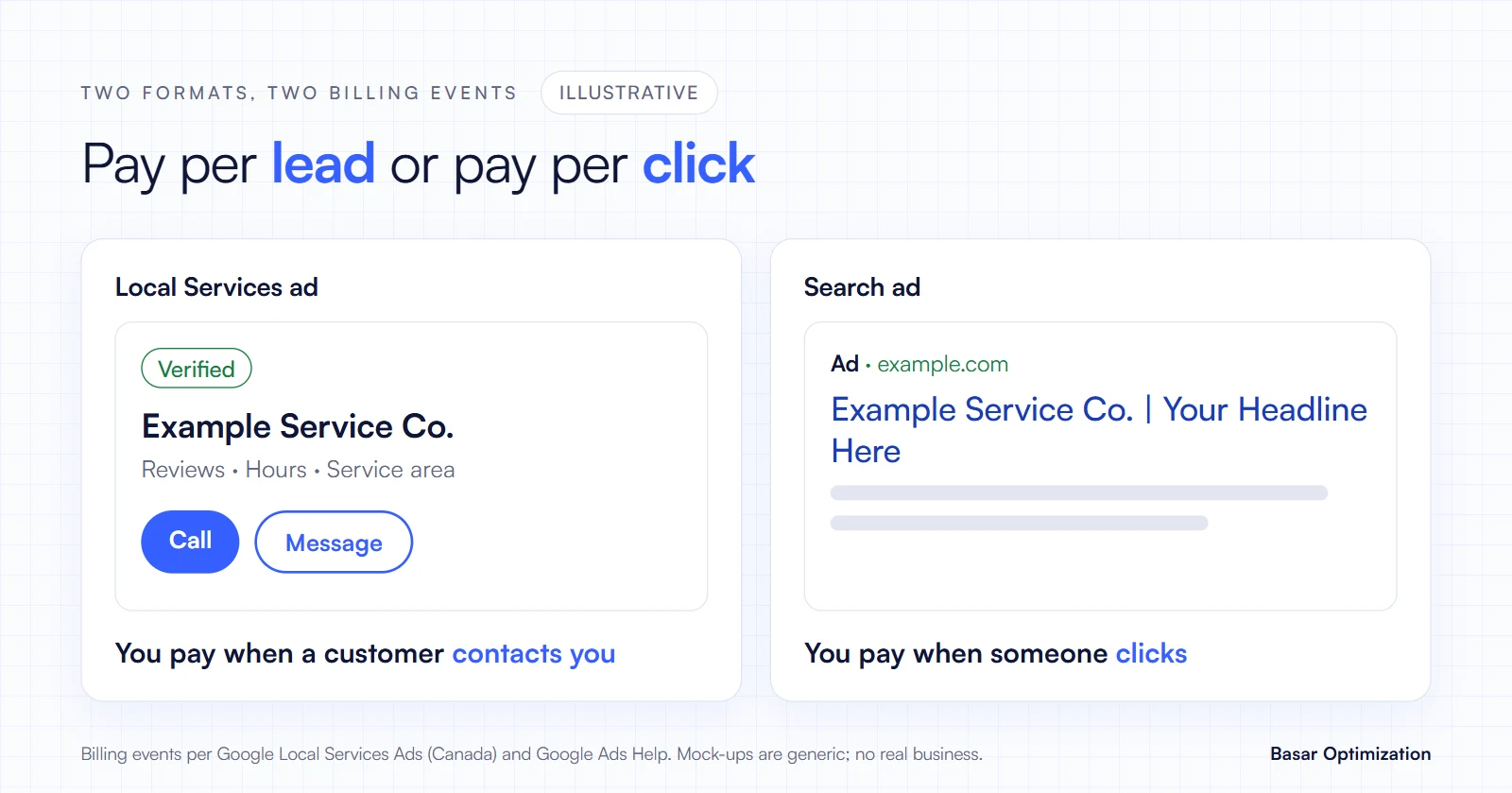
Local Services Ads and Google Search ads both put a service business at the top of a Google results page, but they charge for different events. With Local Services Ads, you pay when a potential customer contacts you through the ad; with Search ads, you pay when someone clicks. That single difference changes who can use each format, how much control you keep and what you need to measure.
The evidence in Google's help documentation points to a clear rule of thumb. Local Services Ads suit a business in an eligible category that can pass screening and answer its phone reliably. Search ads suit any business that needs control over keywords, messaging and the landing page, or whose category is not eligible. Testing both is a reasonable option for an eligible business, and that decision is easier once the mechanics below are understood.
Scope and Method
This paper compares the two formats only on points Google itself documents. Every claim about how the formats work rests on a Google Ads Help, Local Services Help or Google Business page read on 2026-11-22, and each is linked where it is used. Figures on how Canadians get online come from Statistics Canada and CIRA, and evidence on measuring paid-search returns from a National Bureau of Economic Research (NBER) working paper. Where a rule applies only in the United States, the paper says so rather than treating it as Canadian.
Two limits apply. First, no prices appear here: Google publishes no fixed cost per lead or cost per click, because both are set by auctions that vary by location and job type. Second, Google changes these products often, so the rules below describe the documentation as it stood on the date of reading.
1. Two Formats, Two Billing Events
Google Search ads are text ads that appear when a person's search matches keywords an advertiser has chosen. They are usually bought on a cost-per-click basis, which Google defines as paying for each click on the ad, with a maximum CPC (the most you are willing to pay for one click) and an actual CPC that is often lower (Google Ads Help: cost-per-click).
Google Local Services Ads (often shortened to LSA) are a separate format for local service providers. Google's Canadian product page describes them as a way to pay for customers rather than clicks: the advertiser is charged only when a person gets in touch through the ad (Google Local Services Ads, Canada). There is no keyword list and usually no landing page. The ad shows a profile with the business name, reviews, hours and a call or message button, and the contact goes straight to the business (Local Services Ads overview).
That tap-to-call design suits how Canadians get online. Statistics Canada found that 84% of Canadians aged 15 and older had a mobile data plan for personal use in 2022 (Canadian Internet Use Survey, 2022), and in CIRA's March 2024 survey of 2,000 adult internet users, 70% used a smartphone to go online, with the same share in Alberta (CIRA, Trends in Internet Use and Attitudes, 2024).
The practical consequence is a shift in risk. With Search ads, you carry the risk that a click never becomes an enquiry. With Local Services Ads, that risk moves toward Google, which in exchange sets stricter rules on who may advertise and how the business must behave once a lead arrives.
2. Who Can Run Local Services Ads in Canada
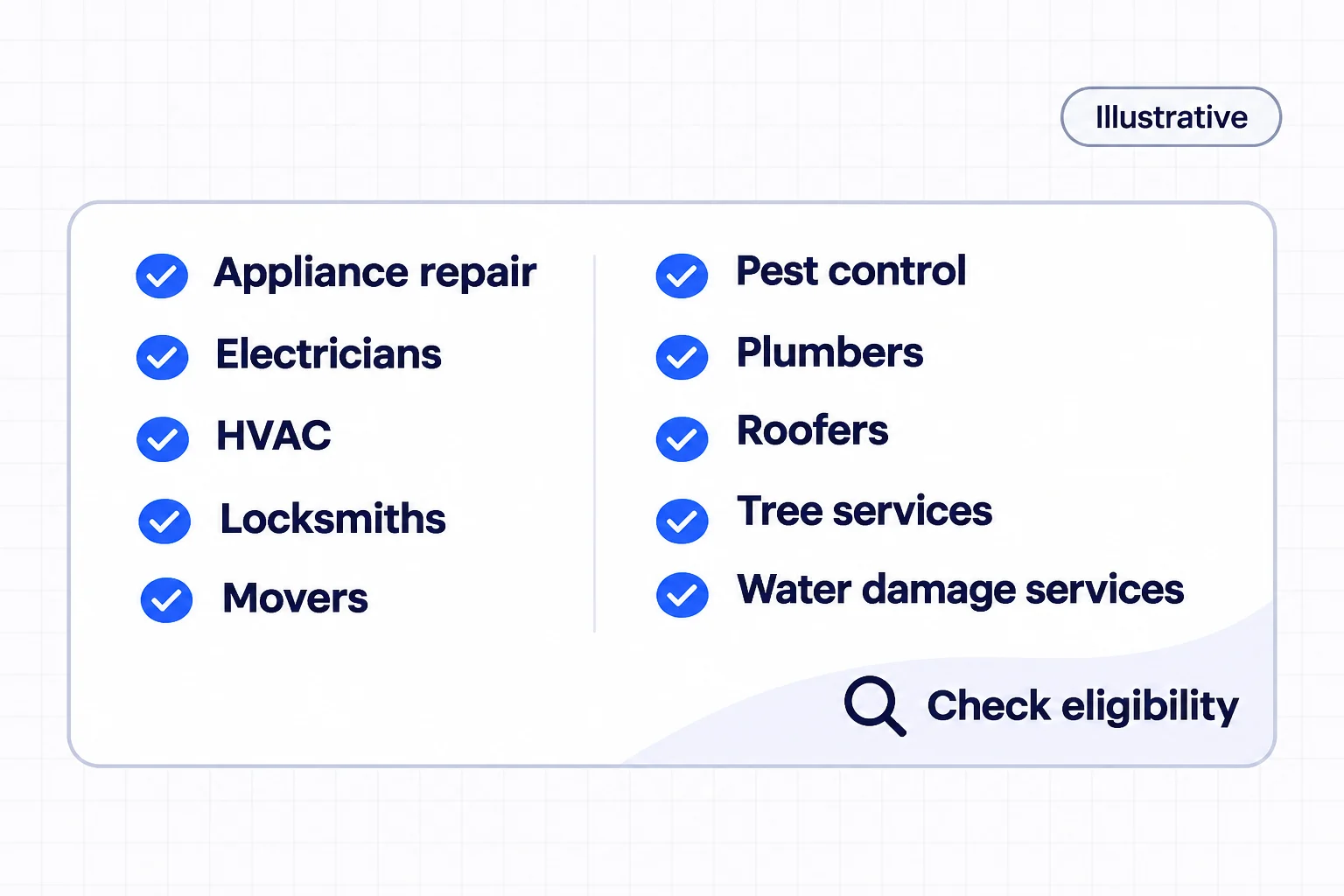
Search ads are open to almost any business that follows Google Ads policies. Local Services Ads are not. Google limits the format to a set list of service categories and points advertisers to an eligibility check by area (Getting started with Local Services Ads, Canada version).
Two Google pages give different pictures of what "eligible" means in Canada, and owners should know both exist:
- The Canada version of the Local Services Help getting-started page lists 16 categories, among them appliance repair, electricians, HVAC, locksmiths, movers, pest control, plumbers, roofers, tree services and water damage services.
- Google's Canadian marketing page for the product lists 36 home services as eligible for the Google Verified badge, a longer list that adds trades such as general contractors, garage door services, landscapers, painters and snow removal.
Neither list replaces the eligibility tool. Before planning any budget around Local Services Ads, run the check for your exact category and service area. A Calgary business whose category is missing simply cannot use the format, and Search ads become the default.
3. Screening, Verification and the Google Verified Badge
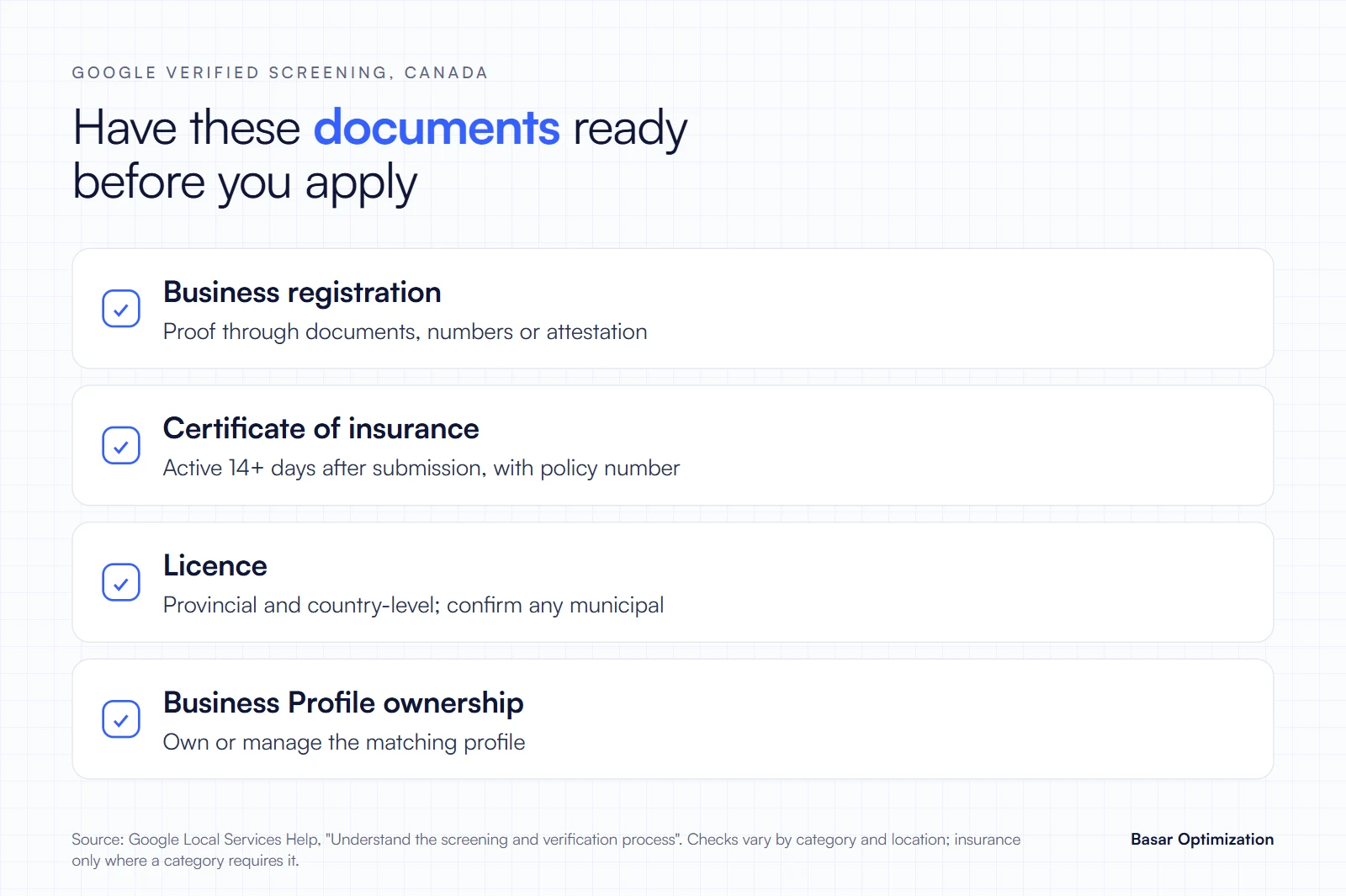
Local Services Ads require every business to pass Google's screening and verification before ads run. According to Google, the checks differ by business category and location and can include background checks, business registration, insurance, licences and a minimum number of reviews (Understand the screening and verification process). Several of these are flagged in Google's documentation as applying to "select users" in Canada, so the dashboard, not a generic checklist, tells you which ones apply to your business.
The Canadian-relevant points in that documentation are worth reading closely:
- Business registration: for Canada, Google asks for proof of registration through documents, registration numbers, attestation or similar means.
- Insurance: where a category requires it, a certificate of insurance must be active for at least 14 days after submission, carry a policy number and match the name you advertise under.
- Licences: Google checks provincial and country-level licences where it can and asks the business to confirm any municipal ones.
- Background checks: in some categories, owners and the field workers who enter customers' properties are checked; the business is not charged for this, and it does not involve a credit check.
- Google Business Profile: the person completing the checks must own or manage the matching Business Profile.
Failure has a cost in time. A business that fails the background check and receives a final disqualification must wait 30 days to reapply, and a second denial extends the wait to 180 days for every later attempt (same source).
From Google Guaranteed to Google Verified
The term Google Guaranteed, the name of the older badge, is still widely searched. Google has replaced it with a single Google Verified badge for all Local Services advertisers. Existing advertisers who had completed verification moved to the new badge automatically, new advertisers earn it by completing screening, and Google states that Local Services Ads ranking is not affected by the change (About Google Verified badge).
The change also ended the Money Back Guarantee attached to the old badge. Google's page set a cut-off: eligible consumers had to request reimbursement for services booked through the ads before December 7, 2025. Any marketing copy that still promises a "Google Guarantee" to customers is therefore out of date and should be removed.
Google also offers pre-badge ads, which let a business receive leads after passing preliminary checks while it finishes onboarding. The trade-off is placement: Google places those listings below providers who have completed every requirement, and pre-badge ads are not offered for garage door services or locksmiths (Getting started with Local Services Ads).
4. How Each Format Decides Who Shows First
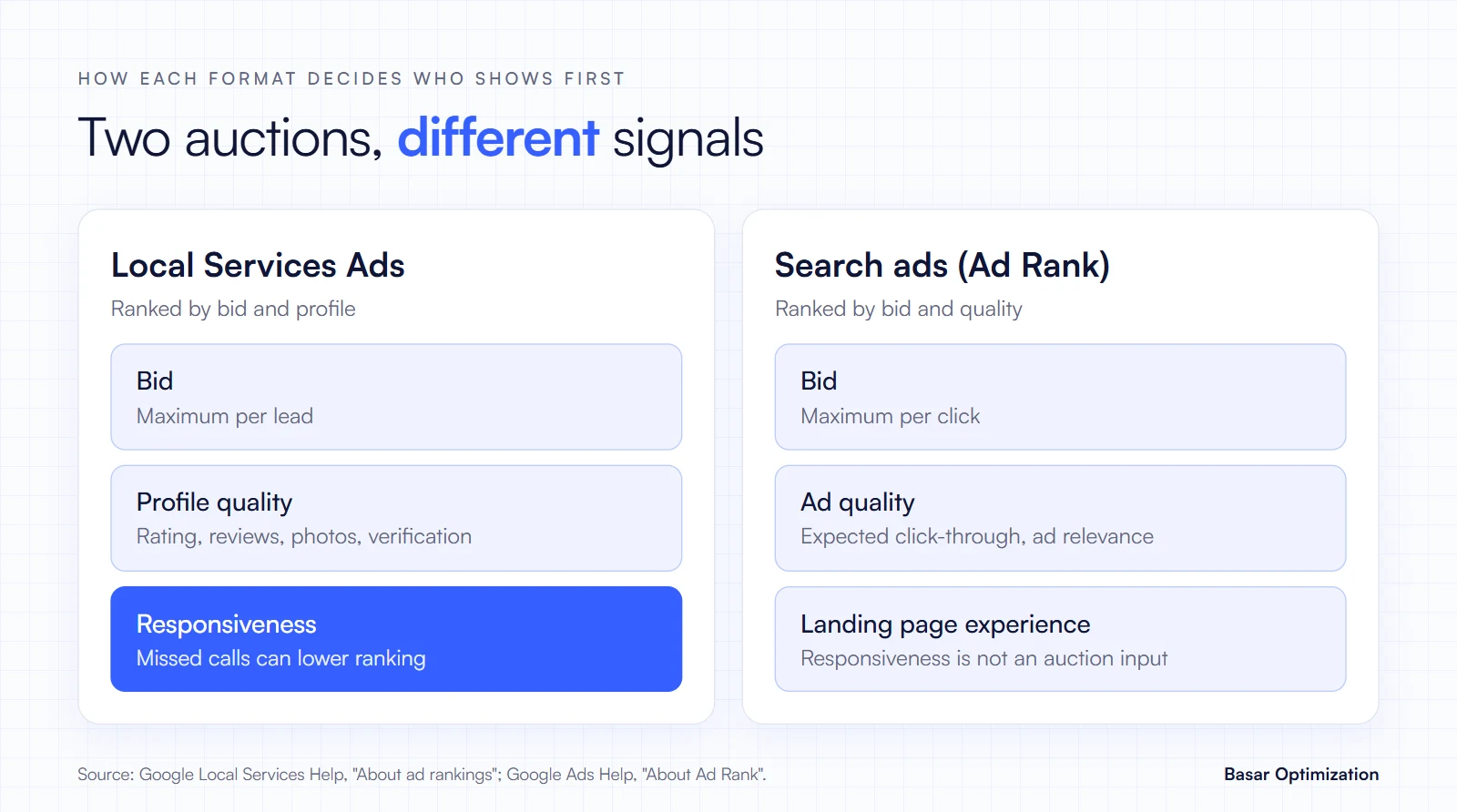
Both formats run auctions, but they weigh different signals. Ad Rank, Google's set of values that decides whether and where a Search ad appears, combines the bid, the quality of the ad and landing page, minimum thresholds, auction competitiveness, the searcher's context and the expected effect of ad assets (About Ad Rank). Quality Score, Google's 1 to 10 diagnostic for a keyword, summarizes part of that quality assessment (About Quality Score).
Local Services Ads order profiles by bid and overall profile quality, and they add something Search ads do not measure in the same way: how the business behaves after contact. Google lists responsiveness to enquiries, the context and relevance of the search, and profile quality, which includes rating, review count, response time, photos and completed verification checks (About ad rankings, Local Services).
| Ranking input | Local Services Ads | Google Search ads |
|---|---|---|
| Bid | Maximum you will pay per lead | Maximum you will pay per click |
| Relevance | Services offered, job types, business bio | Keywords, ad text, landing page |
| Quality signal | Profile quality: rating, number of reviews, photos, verification checks | Expected click-through, ad relevance, landing page experience |
| Behaviour after contact | Responsiveness counts; missed calls can lower ranking | Not an auction input |
| Search context | Service searched, time, location | Search terms, location, device, time and other signals |
| Multiple locations in one area | Only the highest-ranking ad is shown | Each campaign competes under its own Ad Rank |
The row on behaviour after contact deserves the most attention. Google's getting-started page warns that regularly failing to answer calls or messages may affect ranking. A business that sends after-hours calls to a full voicemail box is, in effect, paying a ranking penalty that a Search campaign would not impose.
5. What You Actually Pay For: Valid Leads Versus Clicks
"Pay per lead" sounds simple, so the definition of a lead matters. Google's lead documentation sets out what counts as a valid lead, a contact related to your business that Google charges for (How leads work):
- a call you answer, or a call where you phone the customer back and speak with them;
- an unanswered call inside your business hours, once the caller has waited longer than 20 seconds;
- a text message, email or voicemail from the customer;
- a booking request, which Google offers only in the United States and Canada.
Several details soften or sharpen that picture. A repeat contact from a customer already charged, using the same number or email address, is free if it comes within a 15-day window. Google filters invalid contacts when they first arrive and keeps reassessing charged leads, crediting poor-quality ones automatically; credits usually reach the account balance within 30 days (About automated lead credits). Google also states that it no longer supports credits for leads marked "job type not serviced" or "geo not serviced", which makes accurate service areas and job types a cost control, not an admin detail.
Budget mechanics differ too. You set an average weekly budget, spending can exceed it in a given week, and a monthly ceiling, roughly four and a third times the weekly figure, caps the total (How leads work). Bidding offers three modes: Maximize leads, Target cost per lead and a manual Max per lead, and Google notes that results take about two weeks to settle as its model learns (How bidding works for Local Services Ads).
Lead prices, Google says, vary by location, job type, lead type and bidding mode, with message leads usually priced below phone leads. Search clicks vary with the same auction forces described under Ad Rank. For a structured way to set either budget, the earlier guide on setting a Google Ads budget walks through the reasoning.
6. Control, Measurement and the Landing Page
Control is where Search ads pull ahead. You choose the keywords and how closely a search must match them, through match types (broad, phrase and exact, from widest to narrowest reach) (About keyword matching options). You exclude irrelevant searches with negative keywords, terms that stop an ad from showing (About negative keywords). You write the ad text and choose the landing page, which means you can send a furnace-repair search to a furnace-repair page rather than a generic profile.
Search ads also extend toward the phone. Call assets add a tappable phone number to an ad, and call reporting through a Google forwarding number lets calls count as conversions (About call assets). Location assets pull address and directions from a linked Google Business Profile (About location assets). The wider measurement layer, conversion measurement (recording the valuable actions people take after an ad interaction), is what turns clicks into a cost per enquiry you can compare (About conversion measurement). Our earlier article on tracking calls as conversions covers the call side.
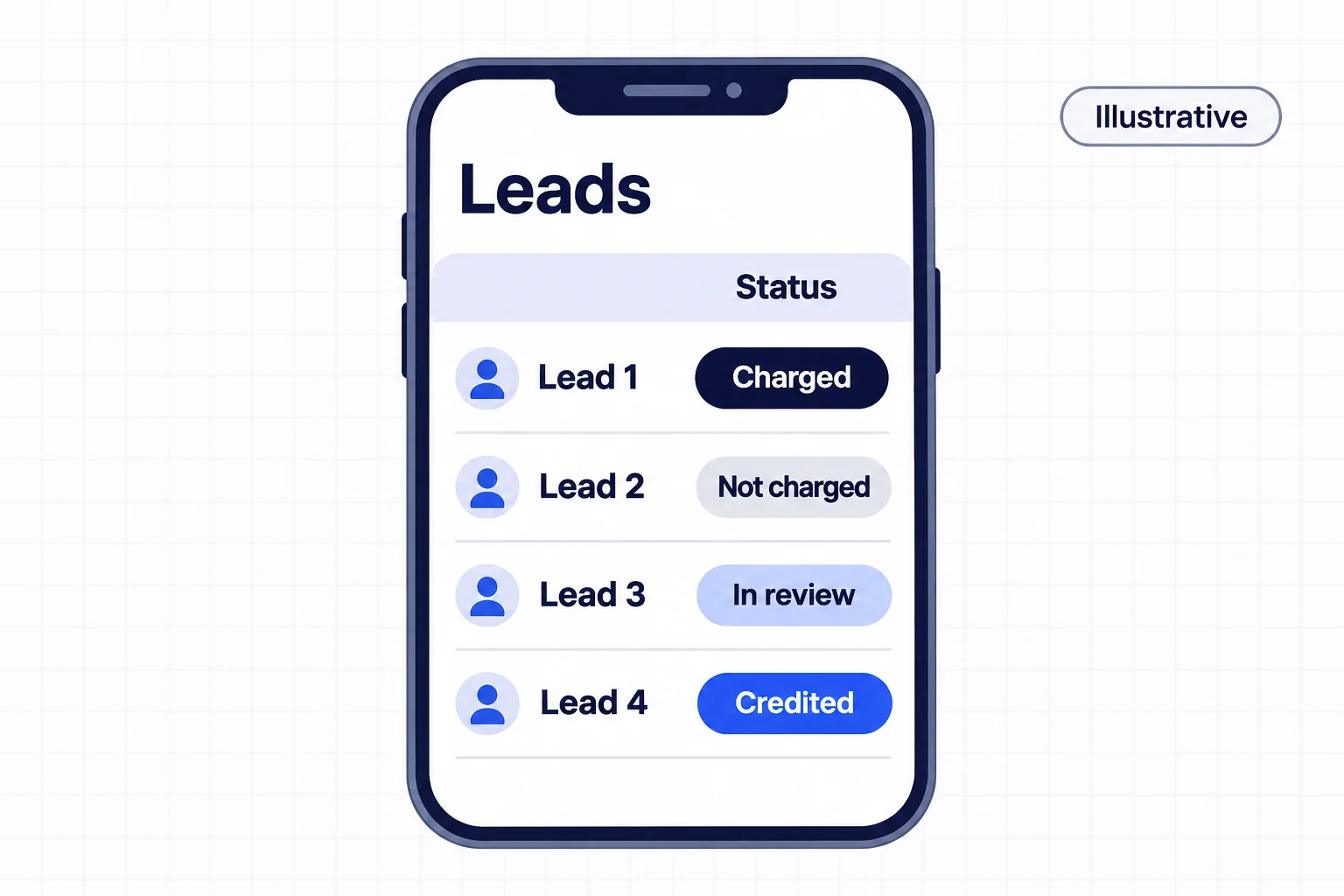
Local Services Ads trade that control for simplicity. You manage service areas, job types, hours and the profile, and you handle leads in an inbox that shows each lead's charge status. If unwanted leads arrive, Google's advice is to narrow service areas, categories and job types, accepting that volume may fall. Because the profile draws reviews from your Business Profile, the work described in our pieces on Google Business Profile optimization and reviews as local trust signals feeds directly into Local Services Ads performance.
7. A Decision Framework for Calgary Service Businesses
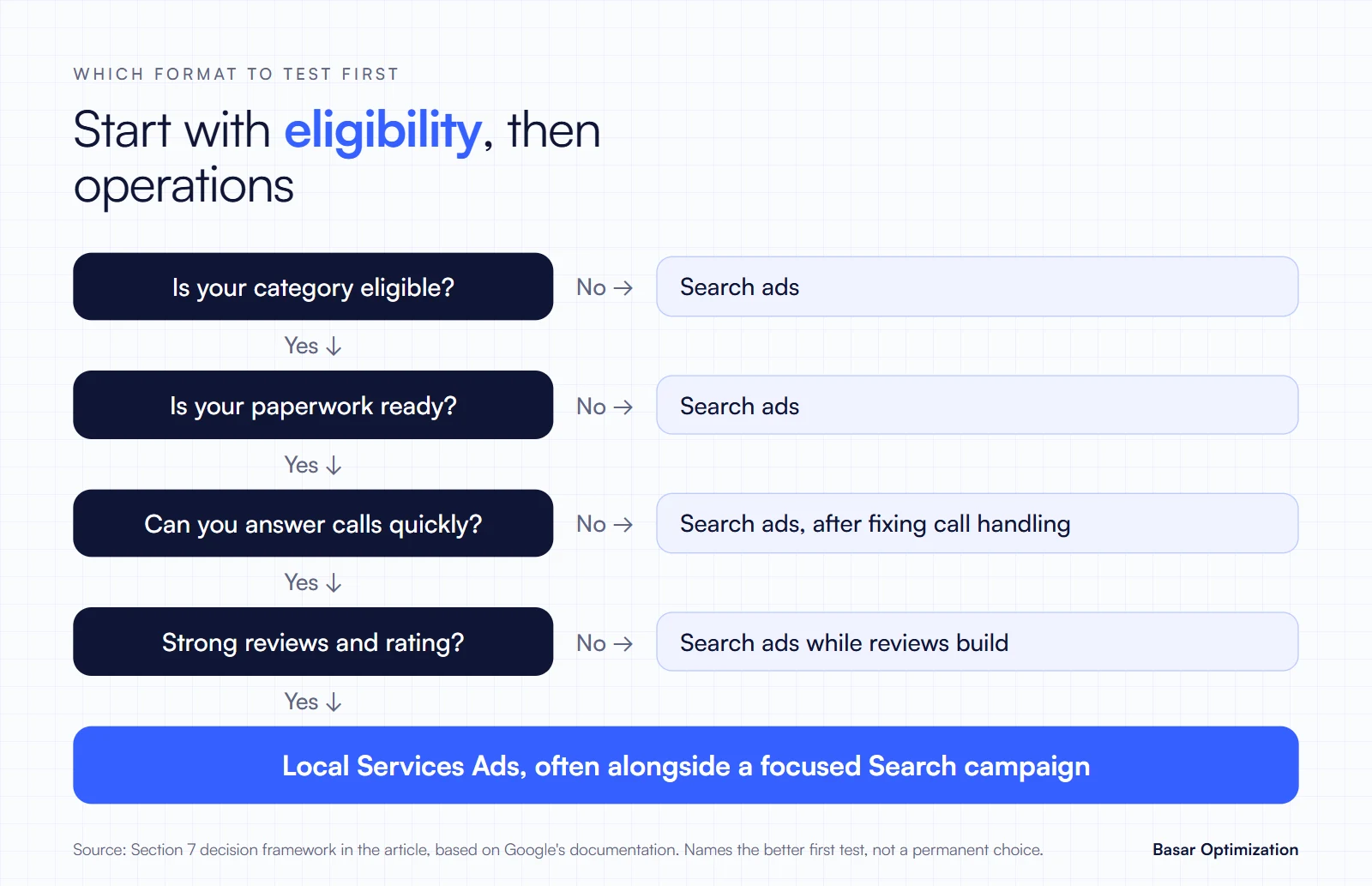
The framework below names the better first test, not a permanent choice, and assumes eligibility for both unless a row says otherwise.
| Your situation | Better first test | Why, based on Google's documentation |
|---|---|---|
| Your category is not on Google's Canadian eligibility list | Search ads | Local Services Ads are offered only for certain categories |
| You can answer calls during business hours and respond to messages quickly | Local Services Ads | Responsiveness is a ranking input, and missed calls over 20 seconds are charged |
| Calls often go unanswered or to a full voicemail box | Search ads, after fixing call handling | Voicemails and long missed calls are valid leads, and missed calls can lower ranking |
| You need to promote one high-value service, not every job you do | Search ads | Keywords, negatives and landing pages let you isolate one service |
| Strong review count and rating on your Business Profile | Local Services Ads | Rating and review count feed profile quality |
| Few reviews or a new profile | Search ads while reviews build | Some categories have minimum review requirements, and profile quality affects rank |
| Insurance, licence or registration paperwork is not ready | Search ads | Screening must be completed before the badge is issued |
| Several locations covering the same part of the city | Plan carefully either way | LSA shows only the highest-ranking ad for one area |
Running both formats at once is possible, and it is not double counting by default. Local Services Ads run in their own ad unit, separate from Search ads, and the two charge for different events. The discipline that makes the combination work is measurement: Search campaigns need conversion tracking to produce a cost per enquiry, and Local Services Ads already report cost per lead, so the two numbers can be compared on the same basis.
A comparable cost is not proof of added value, though. In large field experiments at eBay, the measured return on paid search was a fraction of conventional non-experimental estimates, and ads on brand keywords showed no measurable short-term benefit (NBER working paper 20171, 2014). A business whose own name already ranks well in organic results should therefore judge Search ads on its brand name with particular care.
What this means for your business
For a Calgary service business that has run Google Ads before and was unsure what it bought, the comparison suggests a short sequence of checks:
- Run Google's Local Services Ads eligibility check for your exact category and service area.
- Gather registration, insurance and licence documents before you sign up, and confirm you own or manage the Business Profile.
- Audit how calls are answered during business hours, including voicemail and any phone menu.
- Set service areas and job types precisely, because Google no longer credits leads for work or areas you do not cover.
- If you run Search ads, confirm conversion tracking records calls and forms before judging results.
- Compare cost per enquiry across both formats over the same period, not cost per click against cost per lead.
Call and form conversion tracking, geographic targeting and budget management are part of our Google Ads management work, within the wider paid media services we offer. Organic visibility in the map results, the subject of local SEO, runs alongside both ad formats and shares the same Business Profile.
Conclusion
Local Services Ads and Search ads are not rival versions of the same product. Local Services Ads sell contacts to verified businesses in eligible categories and reward responsiveness and reputation. Search ads sell clicks to almost anyone and reward relevance, landing page quality and careful measurement.
The evidence supports a direct position: choose by eligibility and operations first, budget second. A business that cannot answer its phone, or whose category is not offered, gains little from Local Services Ads. A business with strong reviews, its paperwork in order and fast call handling should usually test them, often alongside a focused Search campaign. If you would like a second view on which format suits your category and lead handling, you can request a quote and we will go through it with you.
Frequently Asked Questions
Are Google Local Services Ads available in Calgary?
They are offered in Canada for a limited set of service categories, such as plumbers, electricians, HVAC, roofers and locksmiths. Availability depends on both the category and the service area, and Google publishes more than one list. The reliable answer for a specific Calgary business comes from Google's eligibility check on the Local Services Ads sign-up page, run for the exact category and the neighbourhoods the business serves.
Is Google Guaranteed still available in Canada?
No. Google replaced the Google Guarantee badge with a single Google Verified badge for Local Services advertisers. Existing verified advertisers moved to the new badge automatically, and new advertisers earn it by completing screening. The Money Back Guarantee tied to the old badge was discontinued, with reimbursement requests accepted only if submitted before December 7, 2025, so any copy that still promises it should be updated.
Do Local Services Ads cost more than Search ads?
There is no fixed answer, because Google publishes no price list for either format. Local Services Ads charge per valid lead, with prices that vary by location, job type, lead type and bidding mode. Search ads charge per click through an auction. The fair comparison is cost per enquiry over the same period, which requires conversion tracking on the Search side.
Can I run Local Services Ads and Search ads at the same time?
Yes. Local Services Ads run in their own ad unit, separate from Search ads, and the two charge for different events, so a business can use both. Running both works best when Search campaigns track calls and form submissions as conversions, so their cost per enquiry can be compared directly with the cost per lead that Local Services Ads already report.
Do reviews affect Local Services Ads ranking?
Yes. Google lists profile quality as a ranking factor, and that includes the business's rating and number of reviews, alongside response time, photos and completed verification checks. Reviews come from the Google Business Profile, and some categories also have minimum review requirements for screening. A business with few reviews may do better starting with Search ads while its review base grows.