
Google Ads Remarketing: How It Works and How to Stay Within Canadian Privacy Rules

Google Ads remarketing shows ads to people who have already visited your website, used your app or given you their contact details. Google now calls these audiences "your data" segments, and using them well takes two things at once: a clean technical setup and a privacy practice that meets both Google's policy and Canadian law.
This article is general information about Google's documentation and Canadian regulators' published guidance. It is not legal advice; for decisions about your own privacy obligations, speak with a privacy lawyer.
What Google Ads remarketing is called now, and what it includes
What advertisers knew as remarketing is now labelled your data throughout Google Ads, and audience types such as in-market and affinity are now called audience segments (About your data segments).
A "your data" segment is a list of people who have interacted with your business. Google's documentation describes several kinds:
- Website visitors, shown ads as they browse sites and apps in Google's Display Network.
- Search follow-ups, where past visitors see your Search ads when they search again after leaving your site.
- Customer Match, built from contact details your customers gave you, matched to signed-in Google users.
- Lead form submitters from lead forms created inside Google Ads.
How remarketing works behind the scenes
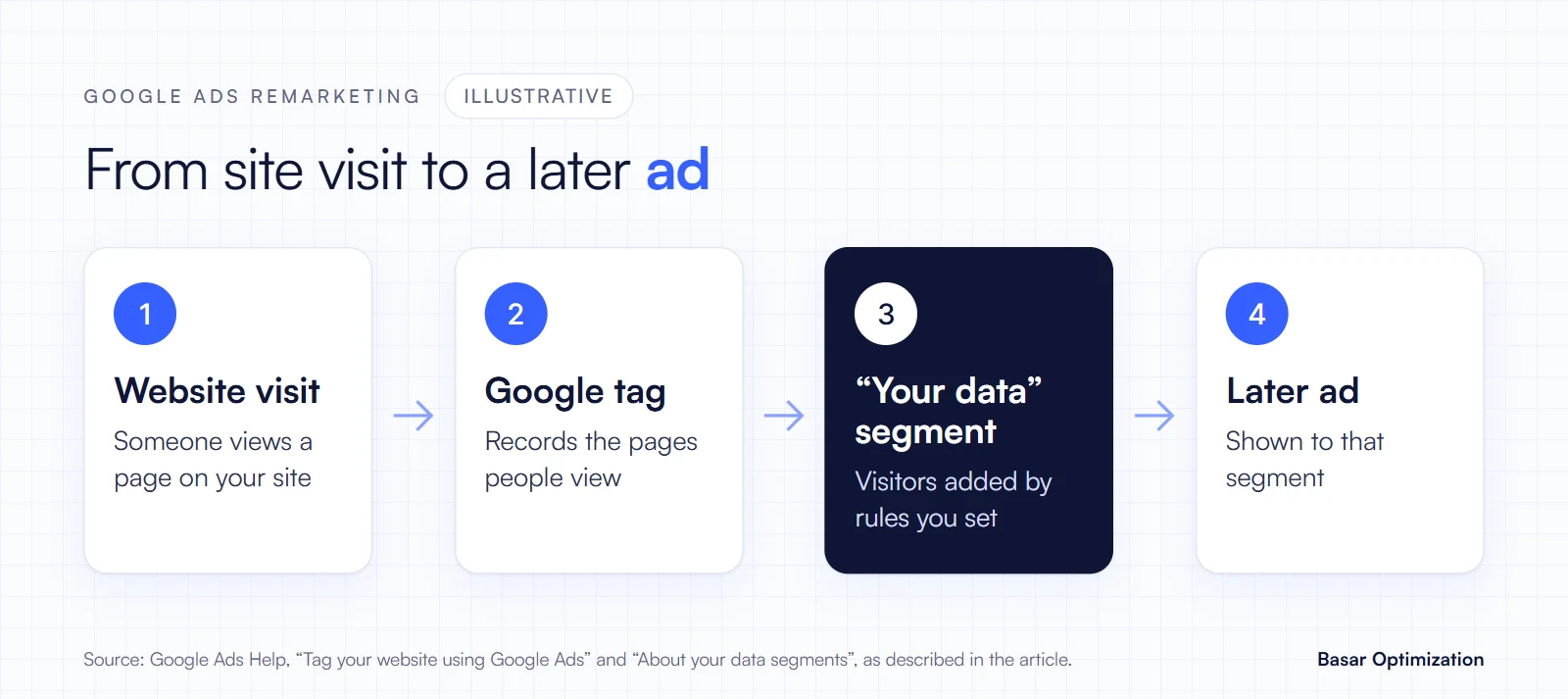
For website visitors, the starting point is the Google tag, a block of code installed on every page of the site. It records the pages people view, including the page address and title, and adds visitors to segments according to rules you set, such as "visited the furnace-repair page in the last 30 days" (Tag your website using Google Ads). Optional event snippets pass extra detail, such as a completed form.
The tag works through cookies. A cookie, in the description used by the Office of the Privacy Commissioner of Canada (OPC), is a small file stored by the browser so a site can recall a visit; when an ad company sets one, it can join up a person's visits to many different sites (OPC fact sheet on web tracking with cookies).
How to set up a remarketing campaign
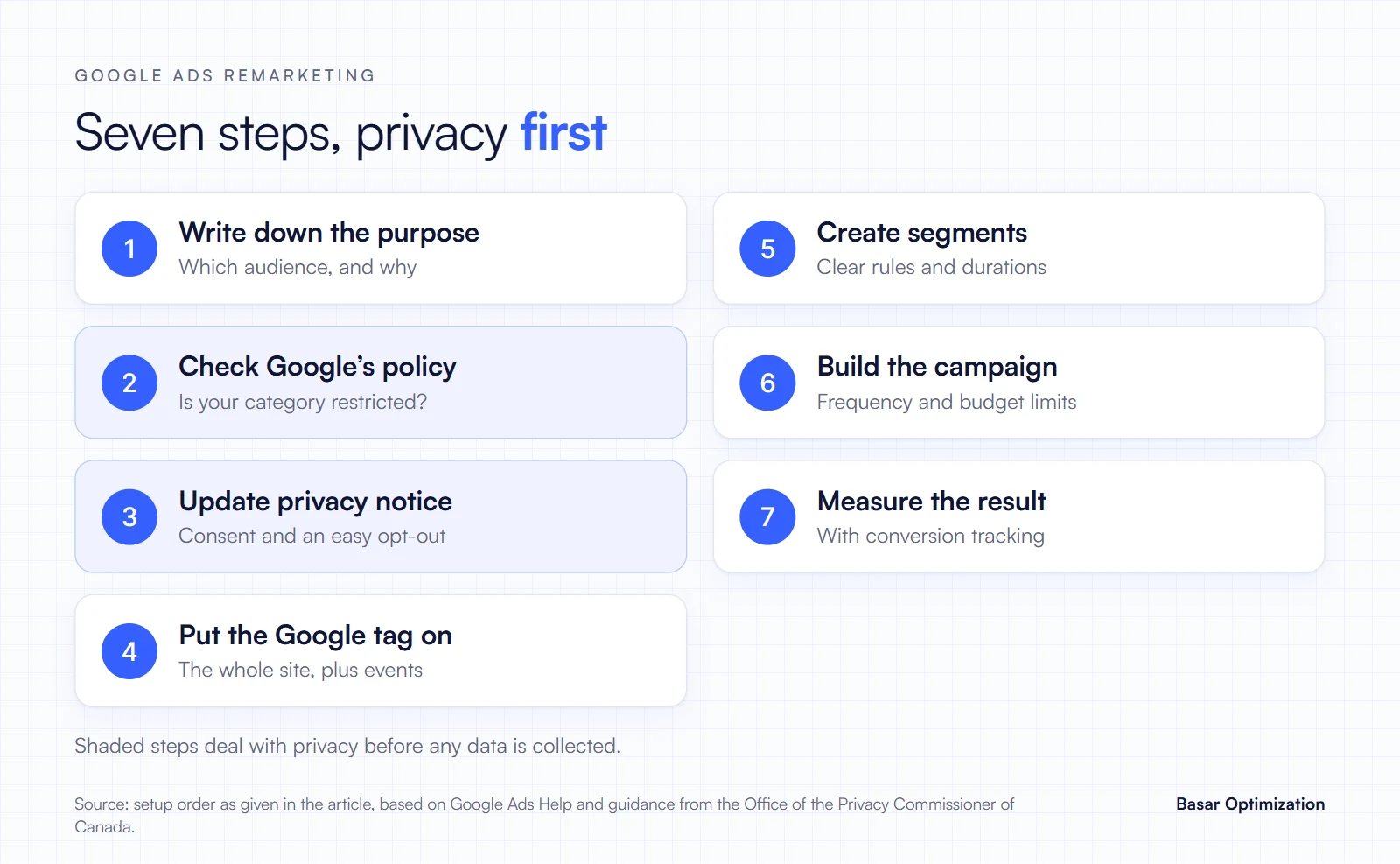
This order deals with privacy before any data is collected:
- Write down the purpose. Decide which audience you want to re-engage and why, for example visitors who viewed a service page but did not request a quote.
- Check your category against Google's policy. If your business falls into a restricted category (covered in the next section), your own segments may not be allowed at all.
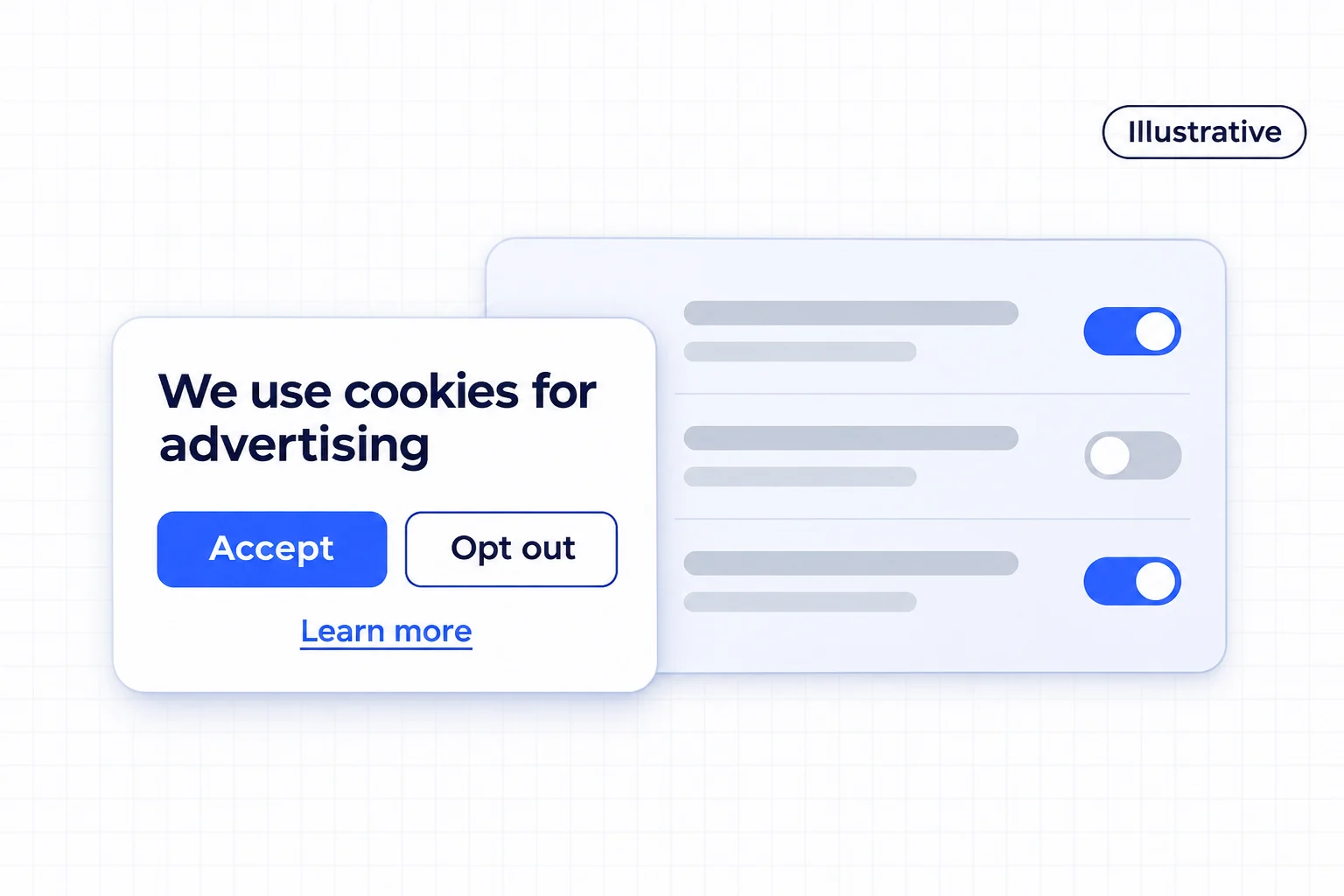
- Update the privacy notice and consent experience so visitors are told about tracking for advertising before or when it happens, with an easy way to opt out.
- Put the Google tag on the whole site, and add event snippets for actions such as a submitted form.
- Create segments with clear rules and membership durations, excluding people who are already customers where the ads would be wasted.
- Build the campaign with ads that match what each segment looked at, and set frequency and budget limits so the same person is not followed relentlessly. Field experiments add nuance: for an online home-improvement retailer, retargeting brought 14.6% more visitors back within four weeks, but its effect faded as time since the first visit grew (Journal of Marketing Research, 2019); for an online travel firm, ads showing the exact product viewed did worse on average than generic ads (Journal of Marketing Research, 2013).
- Measure the result with conversion tracking, so remarketing is judged on enquiries rather than impressions.
What Google Ads policy does not allow
Google's personalized advertising policy, the rule set for any targeting based on people's data, puts firm limits on remarketing (Personalized advertising). The limits that matter most to a Canadian small business are these:
- Sensitive interest categories. Advertisers promoting products or services in categories such as health, financial hardship, relationship difficulties, religious beliefs or sexual orientation cannot use advertiser-curated audiences, which include "your data" segments and Customer Match.
- Access to opportunities (United States and Canada). Housing, employment and consumer finance ads cannot be targeted by gender, age, parental status, marital status or postal-code-style location, although Google accepts the first three characters of a Canadian postal code.
- No personally identifiable information may be passed to Google through tags or tied to cookies and segments.
- No overly narrow segments, including combinations of lists and other targeting that end up aiming at a very small number of people.
- No personalized ads to anyone under 18.
The same policy notes that a site can switch off ad-personalization data collection for individual visitors with a tag parameter, and it points advertisers who use "your data" segments to guidance on what their privacy policy should disclose.
What Canadian privacy rules expect from remarketing
Online behavioural advertising means choosing which ads a person sees from a profile of their browsing on many sites. The federal regulator's position on it is set out in the OPC's guidelines (OPC guidelines on privacy and online behavioural advertising). Three positions in that guidance shape how remarketing should be run:
- In the OPC's view, the browsing data gathered to profile and target people for these ads should normally be treated as personal information under PIPEDA (the Personal Information Protection and Electronic Documents Act, Canada's federal private-sector privacy law).
- It considers opt-out consent potentially reasonable only when several conditions hold together: the purpose is explained plainly rather than buried in a policy, people are told at or before collection, opting out is easy and the choice takes effect at once and lasts, sensitive information is avoided, and the data is deleted or de-identified as soon as possible.
- It advises organizations to avoid tracking children and to avoid technologies that people cannot control or decline.
For a Calgary business, the provincial layer matters too. Alberta has its own statute, the Personal Information Protection Act (PIPA), which the OPC treats as equivalent to the federal law. Generally, a business covered by PIPA answers to the provincial Act for information it handles inside Alberta, while PIPEDA can still apply once information moves across a provincial or national border, and the OPC notes that some organizations must comply with both (OPC: provincial laws that may apply instead of PIPEDA). The Government of Alberta's PIPA page confirms that the Act covers most businesses that collect, use or disclose personal information in the province.
Because remarketing data is processed by Google and may be handled outside Alberta, the interaction between PIPA and PIPEDA for a given setup is exactly the kind of question to put to a privacy lawyer.
Final Thoughts
The evidence from Google and the OPC points to one working principle: tell people plainly, let them say no easily, and keep sensitive categories out entirely. In the OPC's 2025 telephone survey of 1,500 people aged 16 and older, 67% said they do not know where personal information they share online goes or how it is used (OPC survey of Canadians, 2024-25).
Whether Google Ads suits the business at all is the subject of our Google Ads litmus test. Remarketing setup is part of our Google Ads management and wider paid media work, and if you would like a second view on how your segments and tracking are configured, you can request a quote and we will review them with you.
Frequently Asked Questions
Is remarketing legal in Canada?
Federal guidance does not rule it out. The OPC's guidelines say online behavioural advertising may be a reasonable purpose under PIPEDA when it is carried out with clear notice, an easy and lasting opt-out, no sensitive information and limited retention, and is not made a condition of using the internet. Whether a particular setup meets PIPEDA or Alberta's PIPA depends on its facts, so confirm your own case with a privacy lawyer.
What is the difference between remarketing and retargeting?
In practice, none: both mean showing ads to people who have already interacted with your business. "Remarketing" was Google's own term for years, and Google Ads now labels these audiences "your data" segments, while "retargeting" is the general industry word. The same setup, policy limits and privacy expectations apply under every name.
How many visitors does a remarketing list need?
Google requires segments built from website visitors and app users to reach a minimum number of people before ads will serve, and it does not allow segments so narrow that they target a very small group. A low-traffic site may need some time with the tag installed before a segment is usable.
Can a dental or health clinic use Google Ads remarketing?
Usually not with its own segments. Google lists health among its sensitive interest categories, and advertisers promoting products or services in those categories cannot use advertiser-curated audiences such as "your data" segments or Customer Match. Predefined Google audiences remain available. Clinics should also take particular care with privacy, since health information is treated as sensitive by Canadian regulators.