
What Is llms.txt, and Does Your Website Need One?
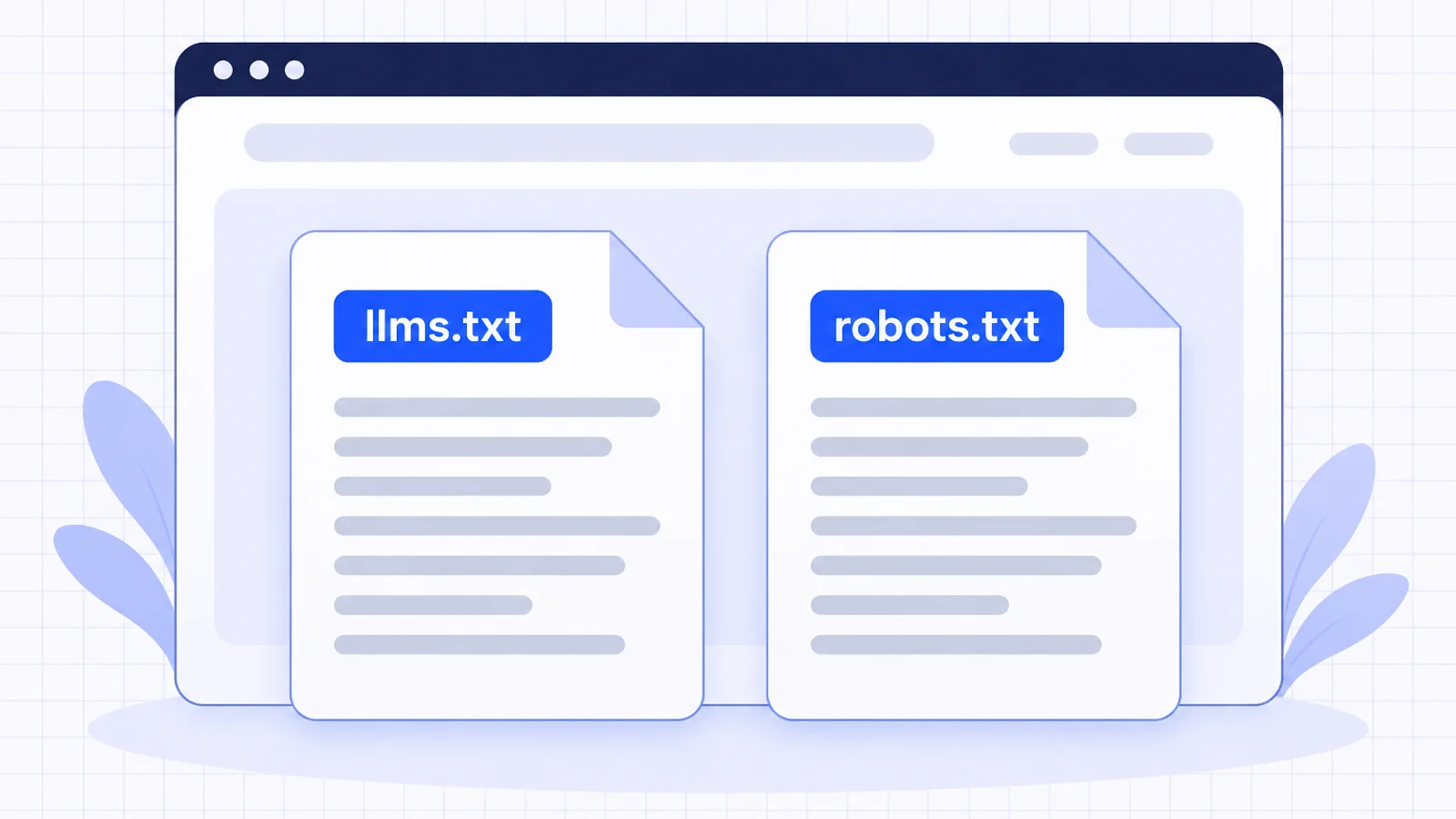
llms.txt is a proposed Markdown file that gives AI tools a short guide to a website and links to clean versions of its key pages. For visibility in Google Search, including AI Overviews and AI Mode, a business website does not need one: Google said in June 2026 that its search engine ignores these files.
What llms.txt is
The idea comes from a public proposal at llmstxt.org, first published by Jeremy Howard on 3 September 2024 and last modified, as version 2, on 10 August 2026. It suggests a Markdown file, plain text with simple formatting symbols, at /llms.txt. Only a heading with the site's name is required; a summary and link lists are optional.
It is meant for AI agents, software that fetches pages on a person's behalf. It is a proposal, not a standard from any standards body, and nothing obliges a search engine or AI company to read it.
Uptake is low. The Web Almanac 2025 found a valid file on about 2% of sites, roughly 40% of them made by one SEO plugin. In Common Crawl's July 2026 sample of 584,107 files, about two-thirds came from templates and half followed the proposal's full structure.
What Google says about it
On 15 June 2026, Google's Search Central documentation log recorded a clarification: llms.txt files are not needed for Google Search and will neither raise nor lower a site's visibility or rankings. Its AI optimization guide lists these files among things a site owner can ignore, and its AI features guide says no AI text file or special markup is needed for AI Overviews or AI Mode.
llms.txt vs robots.txt and AI crawlers
| robots.txt | llms.txt | |
|---|---|---|
| Status | IETF Proposed Standard, RFC 9309 (September 2022) | Public proposal |
| Purpose | Tells crawlers which URLs they may fetch | Offers AI tools a curated summary and links |
| Used by Google Search | Yes | No |
| Controls AI crawlers | Yes, for crawlers that comply | No |
AI crawlers, automated programs that collect pages for AI products, are managed through robots.txt, though compliance varies: in a 40-day study of 130 self-declared bots, bots obeyed stricter rules less often, and AI search crawlers checked the file least. OpenAI's crawler documentation says disallowing its GPTBot token signals that content should not be used to train its models. Google's crawler list says its Google-Extended token controls training and grounding use for Gemini apps without affecting Google Search.
When keeping one is reasonable
Google says keeping llms.txt for other services is fine, and it is reasonable when:
- your site hosts documentation or product detail that AI agents are likely to fetch;
- the file is small, accurate and maintained alongside the pages it lists;
- nobody is charging you for it as a ranking or AI-visibility fix.
For most service businesses, the better hour is spent checking that robots.txt and hosting settings let crawlers reach important pages, an AI-feature fundamental in Google's list. That is the core of our LLM crawler optimization work, alongside generative engine optimization and wider AI SEO. If you would like someone to check which crawlers your site currently allows, you can request a quote and we will look at it with you.
Frequently Asked Questions
Does llms.txt help SEO?
Not for Google. In June 2026 Google stated that llms.txt files are not needed for Google Search and neither help nor hurt a site's visibility or rankings there, including in AI Overviews and AI Mode. Other AI tools may read the file, but none of the sources reviewed here shows a ranking benefit.
Is llms.txt the same as robots.txt?
No. robots.txt is an IETF Proposed Standard, RFC 9309, that tells crawlers which URLs they may fetch, and Google Search obeys it. llms.txt is a public proposal for a Markdown summary aimed at AI tools. It grants or blocks nothing, and Google Search does not use it.
How do I stop AI crawlers like GPTBot?
Use robots.txt rules addressed to each crawler's published user-agent token. OpenAI documents GPTBot for model training, and Google documents Google-Extended for Gemini training and grounding, which does not affect Google Search. An llms.txt file cannot block any crawler. Check each operator's current documentation, because tokens change.
Will adding llms.txt hurt my site?
Not in Google Search. Google says such files are ignored, neither harming nor helping visibility, and that keeping one for other services is fine. The real risk is paying for a file sold as an AI ranking fix while crawl access or content needs attention.