Can ChatGPT Do SEO? How Far to Trust AI Advice About Your Rankings

An evidence review of what large language models can and cannot know about your website, and how to check their advice before it changes anything.
Abstract
Can ChatGPT do SEO? It can help with parts of the work, such as drafting, summarizing and brainstorming, but it cannot be the source of truth for decisions about your rankings. The evidence for that position comes from the model makers themselves, from peer-reviewed research on hallucination and from Google's own guidance on third-party SEO advice. A language model predicts plausible text; it does not consult Google's ranking data, and it has not seen your Search Console account unless you show it.
This paper sets out the mechanism behind confident but wrong answers, summarizes what Google says about AI-generated advice and content, and gives a verification checklist an owner can run before acting. The recommended stance is simple: treat AI advice on SEO as a hypothesis to test, not an instruction to follow.
Scope and Method
The paper covers general-purpose chatbots built on large language models, with ChatGPT as the best-known example, used by a business owner or marketer to get search engine optimization advice. It does not review paid SEO software, and it names no vendors.
Sources were fetched and read on 2026-11-22: OpenAI's research explainer on hallucination (September 5, 2025), the survey by Huang and colleagues (accepted by ACM Transactions on Information Systems), a peer-reviewed audit of citation accuracy, a Canadian survey of internet users, the U.S. National Institute of Standards and Technology (NIST) AI Risk Management Framework page, and Google Search Central documentation. No original experiment was run, so the paper draws conclusions from documented mechanisms rather than from measured error rates on SEO questions. That limit matters: nobody has published a reliable figure for how often chatbots give wrong SEO advice, and this paper does not invent one.
Two earlier Basar Optimization posts sit next to this one. How ChatGPT can support everyday SEO tasks covers practical uses, and AI SEO tools compared with human SEO experts weighs tools against people. This paper asks a narrower question: how much weight should a chatbot's SEO advice carry?
1. What "Doing SEO" Involves, and Which Parts a Chatbot Can Touch
Search engine optimization (SEO) is the work of helping search engines crawl, understand and show your pages, and helping the people who find them choose you. Google's own description of what an SEO provider does is broad: reviews of site content and structure, technical advice on hosting, redirects and error pages, content development, keyword research, training, market expertise and optimizing for generative AI (Google Search Central, "Do you need an SEO?", updated 2026-06-05).
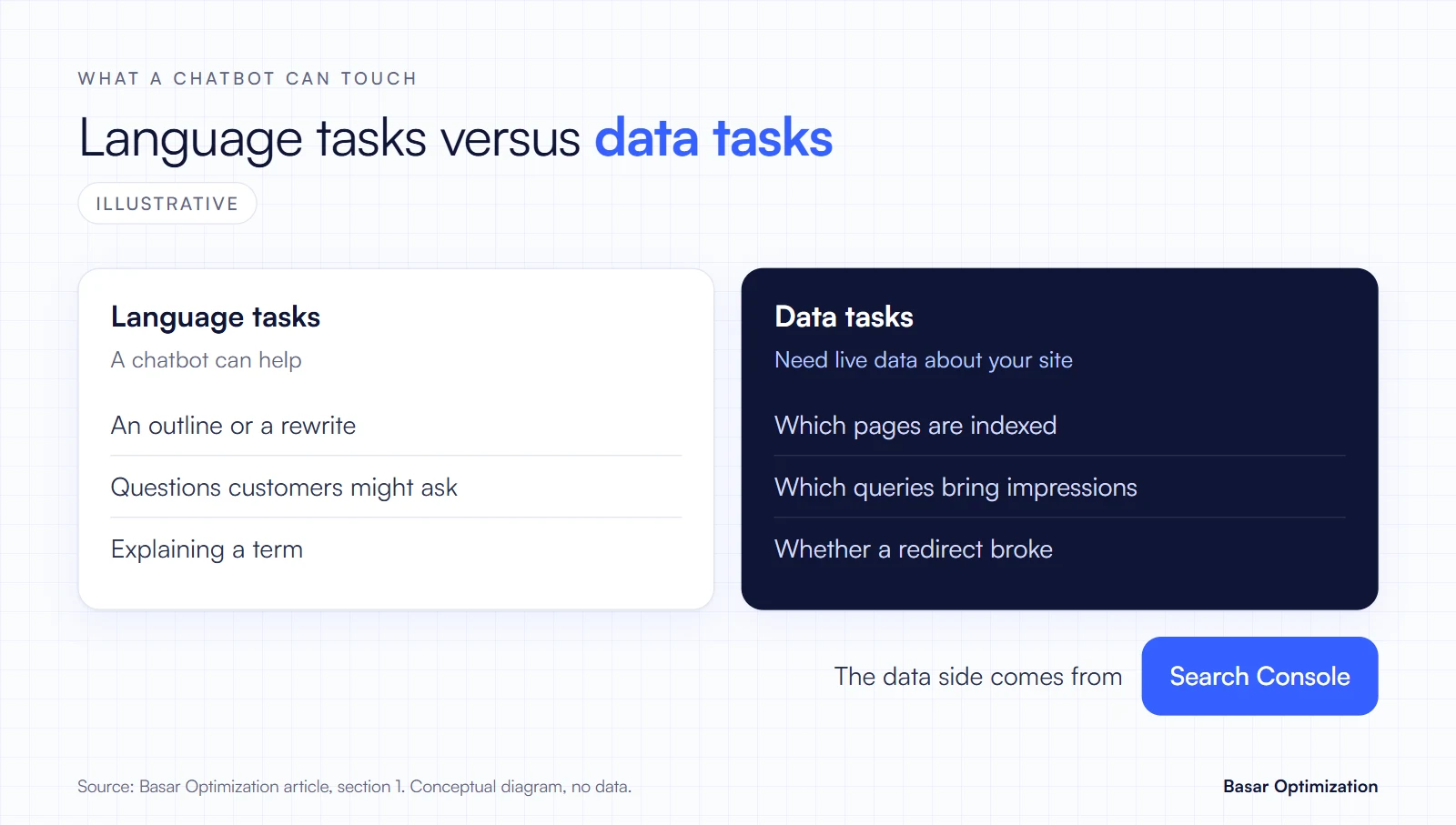
A large language model (LLM) is software trained on very large amounts of text to predict the next word in a sequence; ChatGPT is a chat interface built on such models. That design makes it good at tasks where the output is language: an outline, a rewrite, a list of questions customers might ask, an explanation of a term. It makes it weak at tasks where the output must be a fact about one specific website, one market or one point in time. Owners will ask it anyway: in CIRA's 2026 Internet Trends survey of 2,000 adult Canadian internet users, 46% had used a generative AI tool in the past year, and 52% of those users had used one as a search engine.
Most of the decisions that move a small business's search visibility fall into the second group. Which pages are indexed, which queries already bring impressions, whether a redirect broke during a redesign, whether a competitor's profile outranks yours in the map results: each is a question about live data. A chatbot can help you reason about that data once you have it. It cannot supply the data itself.
2. Why a Language Model Can Sound Right and Still Be Wrong
The mechanism
A hallucination, in the research sense, is output that reads as fluent and confident but is not true. The survey by Huang and colleagues describes LLMs as prone to producing this kind of plausible but nonfactual content, and treats it as a central reliability problem for any system people use to find information (arXiv 2311.05232). The authors also note that retrieval-augmented systems, which look up documents before answering, still face limits in preventing it.
OpenAI's explanation is more specific about the cause. During pretraining, a model learns from text that carries no true or false labels, so it learns what fluent language looks like rather than which statements are correct. Regular patterns such as spelling become reliable with scale, but arbitrary facts that appear rarely in the training text cannot be inferred from patterns, and those are where invented answers appear (OpenAI, "Why language models hallucinate", September 2025). OpenAI adds that common evaluation methods reward a guess over an admission of uncertainty, which pushes models toward confident answers.
Why SEO questions are exposed
Facts about your website are the clearest case of rare, specific facts. Your page titles, your crawl errors, the date your old site went offline and the queries your service page ranks for are close to absent from any training text. When a chatbot answers a question about them without being given the data, it is filling a gap with what is typical, not what is true for you.
Google makes the same point about AI-written content in general. Its guidance states that generative models do not look facts up; they generate the most probable next words, so their output can contain inaccuracies, and it asks publishers to fact-check AI-generated text, including metadata, before it goes live (Google Search Central, generative AI content guidance, updated 2026-10-01). Advice is no different from content: the same prediction engine writes both.
The confidence problem
The practical danger is tone, not error rate. A wrong answer about which redirects to remove, or whether a "noindex" tag (an instruction telling search engines not to list a page) is safe to add, can remove pages from search. Because the model is rewarded for sounding certain, its mistakes rarely announce themselves.
3. What Google Says About Third-Party and AI SEO Advice
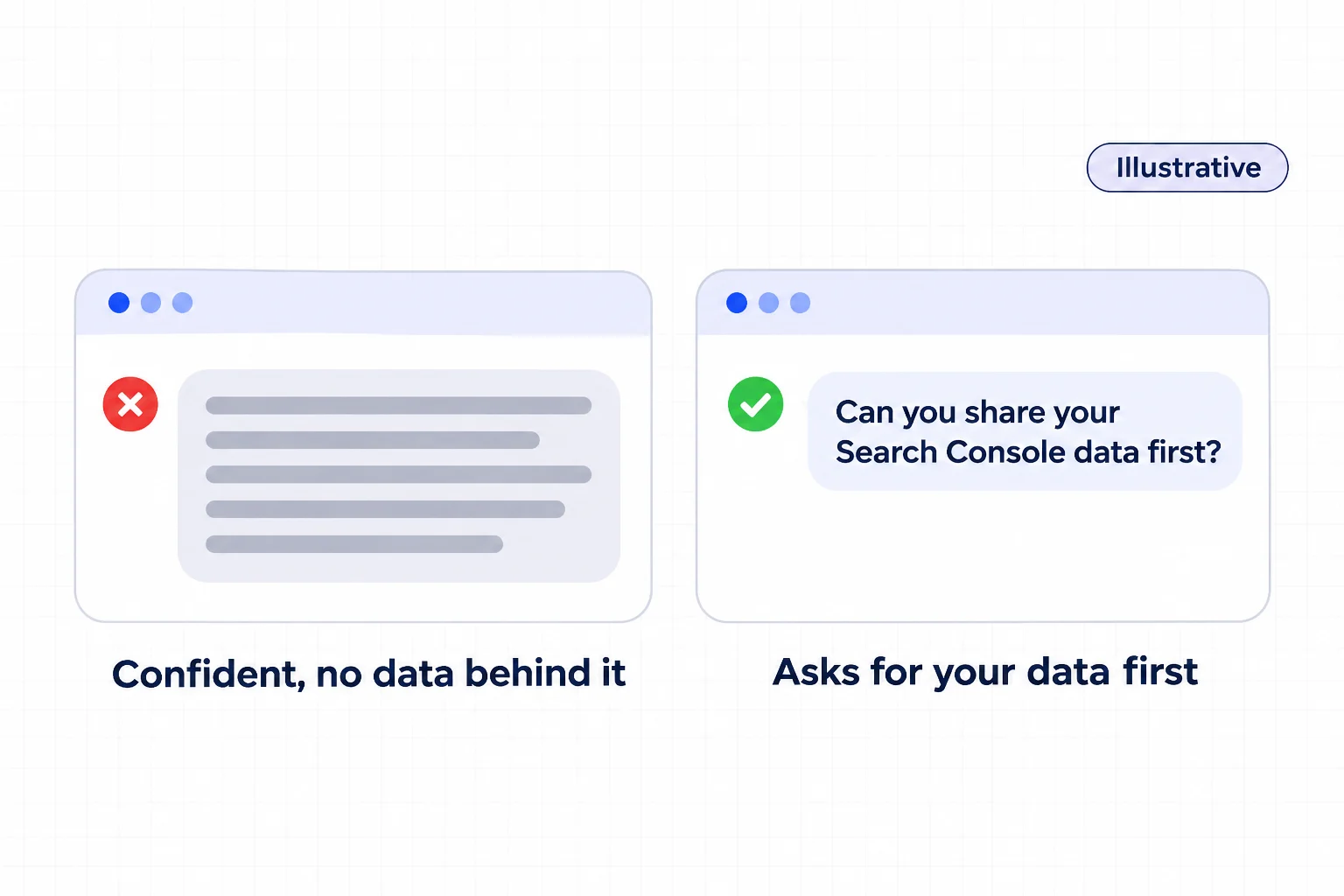
Google published guidance in 2026 aimed directly at outside SEO advice, including advice about AI search experiences, the territory of AEO (answer engine optimization) and GEO (generative engine optimization, improving whether and how a business appears, and is cited, in AI-generated answers). Its central instruction is to evaluate any advice against Google's official documentation. Good advice, in Google's framing, either presents itself as an opinion grounded in data or experience, or cites official sources; weaker advice claims to know what "Google says" without showing where (Google Search Central, guidance on third-party SEO tools and advice, updated 2026-06-05).
Three points from that page bear on chatbots. First, Google does not evaluate or approve outside services, so a claim of being "approved" deserves suspicion. Second, outside tools cannot see the ranking data Google keeps internally and cannot guarantee performance; their predictions are their own. Third, Google recommends Search Console, its free first-party tool, as the source of data that comes directly from Google Search. A general-purpose chatbot is an outside tool in every sense of that page: it has no ranking data, no guarantee and no special status.
The "Do you need an SEO?" page adds a test that applies equally to a person or a model: before making significant changes based on an outside audit, check the recommendations against official guidance, and ask whether they cite Google's documentation as evidence. The same page is blunt that no one can guarantee a top ranking on Google.
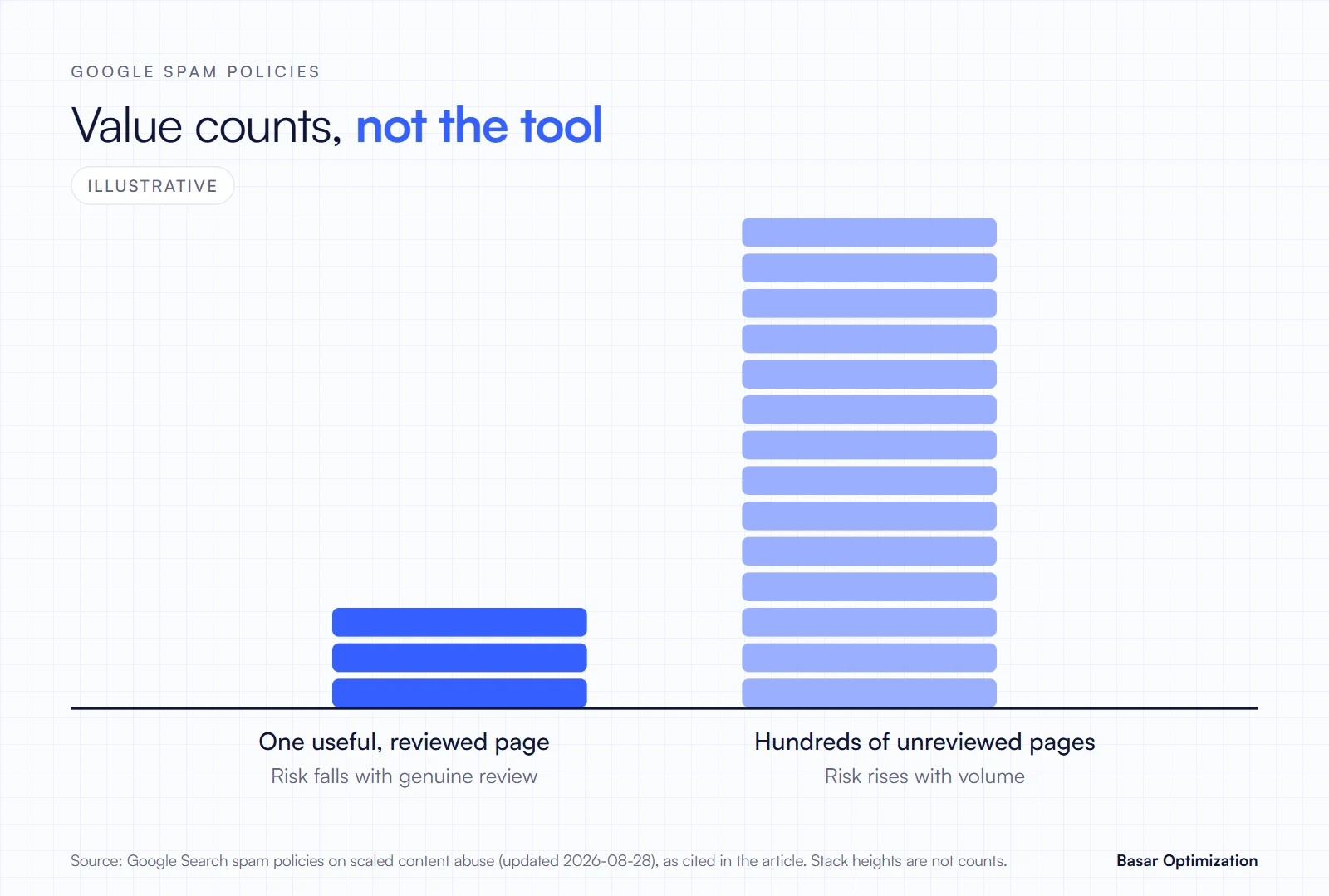
On content, the line is about value, not authorship. Google's spam policies define scaled content abuse as producing many pages mainly to manipulate rankings rather than help users, whatever the method, and list generating many pages with generative AI tools without adding value as one example (Google Search spam policies, updated 2026-08-28). Using a chatbot to help write one useful, reviewed page is a different act from publishing hundreds of unreviewed ones. The risk rises with volume and falls with genuine review.
4. ChatGPT for SEO: Where It Helps and Where It Should Not Decide
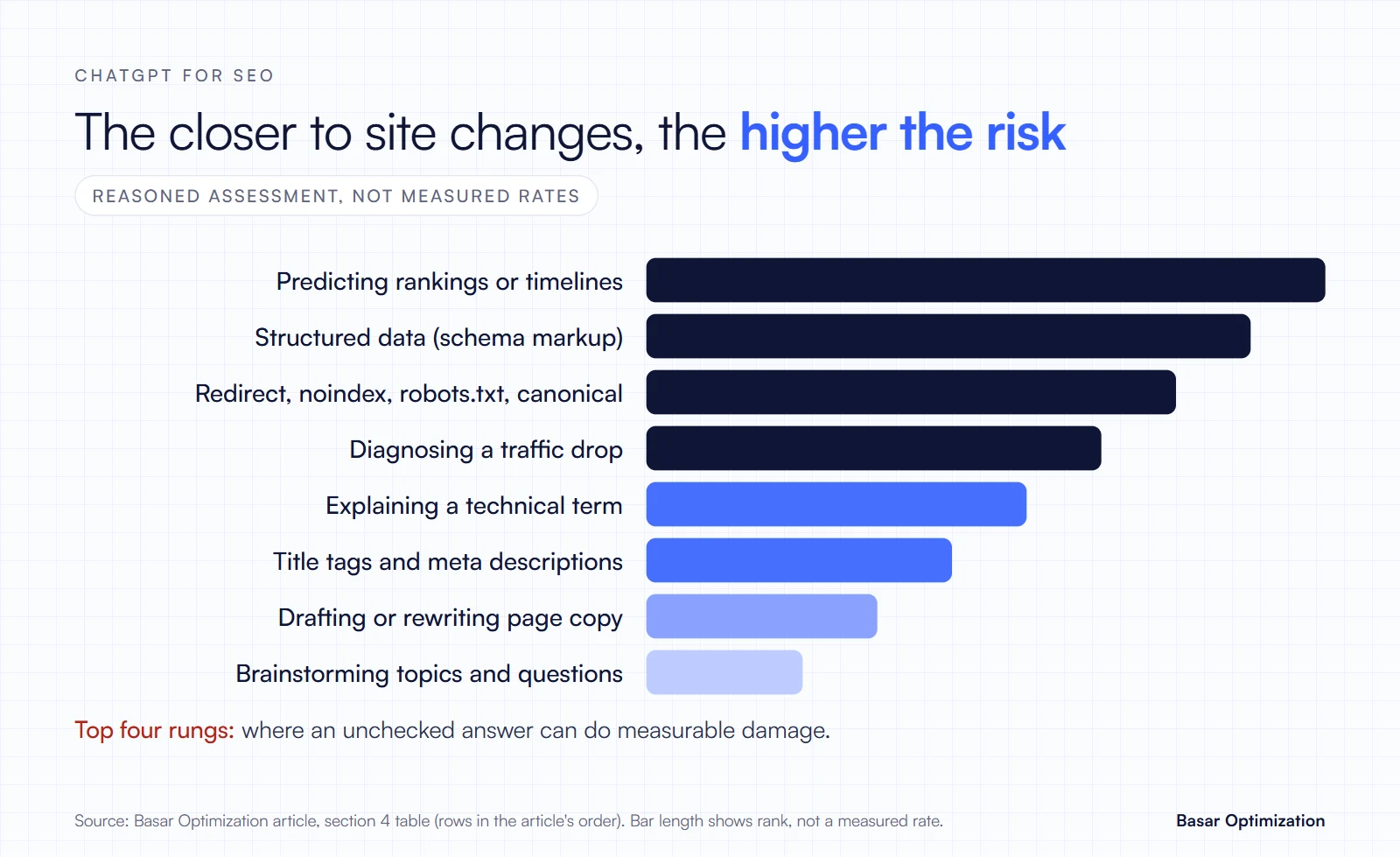
The useful question is not whether to use ChatGPT for SEO but which decisions it may inform. The table sorts common tasks by what a model can add and where the risk sits. The risk column follows from the mechanism in Section 2; it is a reasoned assessment, not a measured error rate.
| SEO task | What a language model can add | Main risk | Check before acting |
|---|---|---|---|
| Brainstorming topics and customer questions | Fast first list of angles and phrasings | Ideas with no real search demand | Compare with Search Console queries and keyword research |
| Drafting or rewriting page copy | Structure, clearer sentences, alternative headings | Invented facts, prices, claims or sources | Fact-check every figure; human edit before publishing |
| Writing title tags and meta descriptions | Several options to choose from | Wrong claims about the page; duplicates | Read against the page; check lengths |
| Explaining a technical term or error | Plain-language explanation | Outdated or invented detail | Confirm in Google Search Central documentation |
| Diagnosing a traffic drop | A list of possible causes to investigate | A confident single cause with no data behind it | Search Console Performance and Pages reports; dates of site changes |
| Redirect, noindex, robots.txt or canonical changes | Explaining what each directive does | Removing pages from search by mistake | Test with URL Inspection; have a developer or SEO review |
| Structured data (schema markup) | A first draft of JSON-LD | Markup that does not match the page | Validate the code and compare it with the visible text |
| Predicting rankings or timelines | Nothing reliable | False certainty | Do not rely on it; no one can guarantee rankings |
The further a task sits from language and the closer it sits to live data or site configuration, the less a chatbot's answer should count on its own. The bottom four rows are where an unchecked answer can do measurable damage.
5. A Verification Checklist Before You Act on AI SEO Advice
Each step turns a chatbot's suggestion into a testable claim; run them before anything changes on the live site.
- Restate the advice as a testable claim. "Your blog is hurting your rankings" is vague; "pages X and Y have impressions but no clicks" can be checked.
- Ask the model for its source, then open the source yourself. If it names a Google document, read that page. If it cannot point to one, treat the advice as opinion, as Google's third-party guidance suggests. A citation is not proof by itself: in a human-evaluation audit of four generative search engines (Findings of EMNLP 2023), only 51.5% of generated sentences were fully supported by their citations, and 74.5% of citations supported their sentence.
- Check the claim against Search Console. The Performance report shows the queries and pages that already earn impressions and clicks, and Google states that traffic from AI Overviews and AI Mode is included there under the "Web" search type (Google Search Central, AI features and your website).
- Inspect the specific URL. The URL Inspection tool in Search Console shows whether a page is indexed and what HTML Googlebot received, which settles many technical questions a chatbot can only guess at.
- Look for a guarantee. Any promise of a ranking position or a fixed timeline fails Google's own test, whoever makes it.
- Change one thing at a time, and write down the date. A dated change log lets you see later whether a movement in traffic coincided with your edit or with something else.
- Escalate configuration changes. Redirects, robots.txt rules, canonical tags and noindex directives deserve a second human review, because a mistake there can hide pages from search.
The checklist does not ask you to distrust AI, only to give it the scrutiny Google recommends for any outside adviser, an agency included.
6. The Counter-Argument: Models Keep Improving
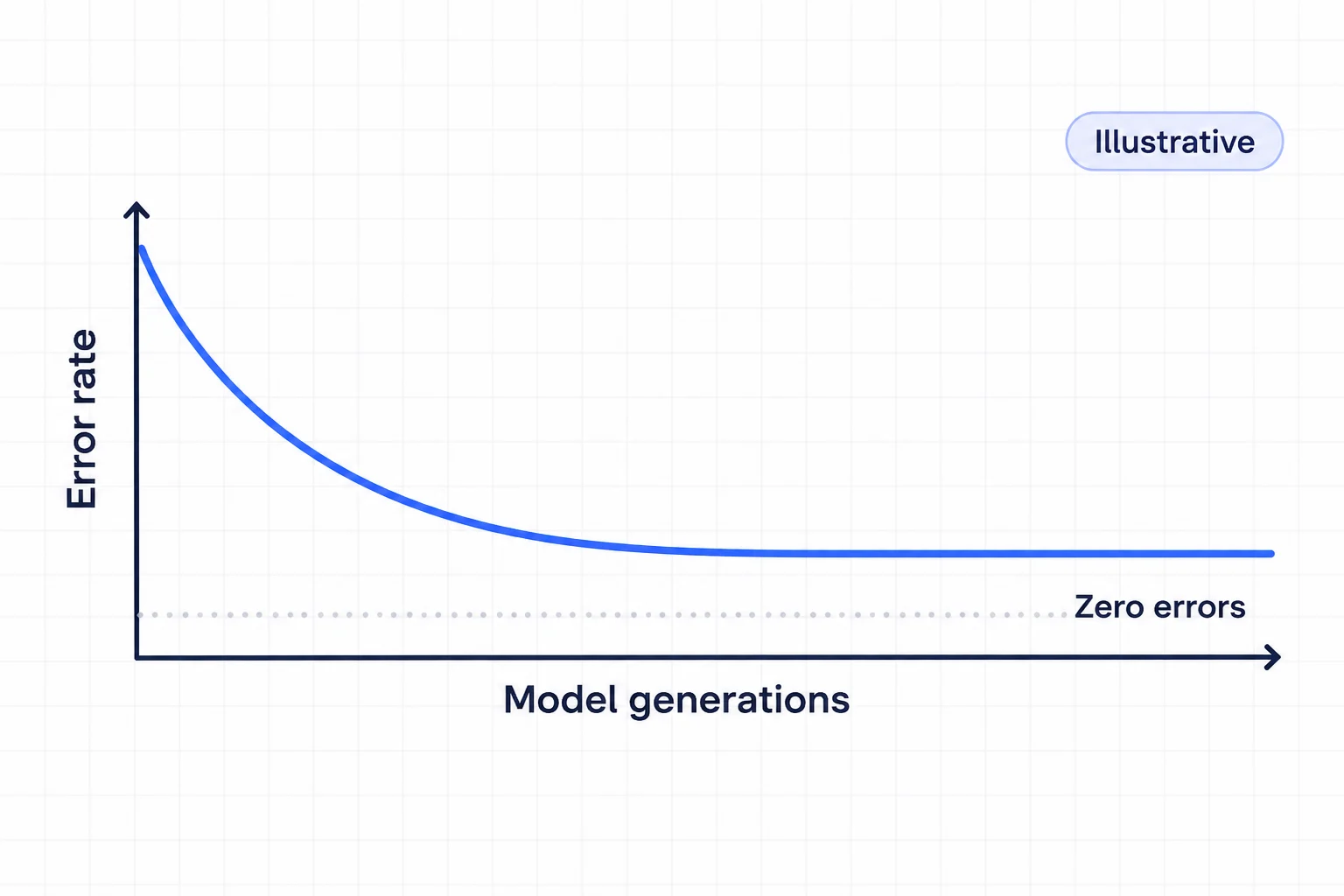
The strongest objection to this stance is that the models are getting better, so caution written today will age badly. Part of that is true. OpenAI reports that its newer models hallucinate significantly less, especially when reasoning, and that it is working to reduce the rate further.
The same source, however, rejects the idea that the problem disappears with progress. OpenAI's position is that accuracy will never reach 100 percent, because some real-world questions cannot be answered from the information available, regardless of model size or reasoning ability. It also says that a model which abstains when it does not know is behaving correctly, and that evaluation methods should reward that behaviour. A better model, on this account, is one more likely to say "I need your data," not one that knows your data without being shown it.
Risk frameworks point the same way. NIST's AI Risk Management Framework, released January 26, 2023 and intended for voluntary use, exists to help organizations build trustworthiness into how they design, use and evaluate AI systems; NIST added a Generative AI Profile in July 2024 to help organizations identify risks specific to generative AI (NIST AI RMF). A small business does not need to adopt a federal framework to draw the lesson that checking an AI system's output is part of using it well. Google states the business-owner version of that premise plainly on its SEO hiring page: the owner remains accountable for whatever a hired company does to the site.
The improving-model argument therefore changes the size of the risk, not its shape. Fewer errors still means some errors, and a confident error in a redirect plan costs the same whether it came from an older or a newer model.
What This Means for Your Business
For a business owner who has already paid for SEO once and is deciding what to do next, the evidence supports a clear division of labour.
- Use a chatbot for language work. Outlines, drafts, rewrites, question lists and explanations save time, provided a person checks every fact before publishing.
- Use first-party data for decisions. Search Console, your analytics and your own records of site changes are the evidence base; a chatbot can help you read them once you export or paste them in.
- Hold every adviser to the same standard. An AI answer, a freelancer's audit and an agency report should each cite Google's documentation or label themselves as opinion, and none should promise a ranking.
- Keep configuration changes under human review. The technical rows of the table in Section 4 are where small mistakes have the largest consequences.
The same reasoning applies to the AI search experiences themselves. Google's guidance says no special files or markup are needed for a page to show up in AI Overviews or AI Mode and that standard SEO fundamentals still apply, which is why AI-specific work belongs inside a broader AI SEO program rather than replacing search engine optimization fundamentals. If you would like someone to read an AI-generated SEO plan against your own Search Console data before you act on it, you can request a quote and we will walk through it with you.
Conclusion
So, can ChatGPT do SEO? It can do some of the writing that SEO involves, and it can help a person think through a problem. It cannot see Google's ranking systems, it has not seen your site's data unless you supply it, and by its makers' own account it will sometimes answer with confidence when it should admit it does not know.
The evidence-led position is therefore neither enthusiasm nor rejection. AI advice about your rankings is a hypothesis. Search Console, Google's documentation and a careful human review are how you test it. Businesses that keep that order, model first for ideas and data first for decisions, get the speed of the tools without handing them decisions they are not built to make.
Frequently Asked Questions
Can ChatGPT do SEO for my website on its own?
No. ChatGPT can draft copy, suggest topics and explain terms, but it cannot see your Search Console data, Google's ranking systems or your site's configuration unless you supply them. Decisions about indexing, redirects, technical fixes and which pages to improve need live data and human review. Treat its output as a first draft or a hypothesis, then verify it.
Is ChatGPT SEO advice accurate?
Sometimes, but not reliably enough to act on unchecked. Language models predict likely text rather than look up facts, so they can produce confident answers that are wrong, especially about specific websites. Google advises checking any outside SEO advice against its official documentation and looking for cited sources. If an answer cannot point to a source you can open, treat it as opinion.
Will Google penalize content written with ChatGPT?
Google's policies target the purpose and value of content, not the tool used to write it. Its spam policies treat generating many pages with AI tools without adding value for users as scaled content abuse. A single page drafted with AI help, fact-checked and edited to be genuinely useful, is a different case. Google also asks publishers to review AI-generated text and metadata for accuracy.
Can ChatGPT see my Google rankings?
Not by itself. Google states that third-party tools cannot see the ranking data it keeps internally, and a general chatbot is a third-party tool. The reliable source for your own search performance is Google Search Console, which reports queries, clicks, impressions and indexing status directly from Google. You can export that data and ask a chatbot to help you read it.
Should I stop paying for SEO and use AI instead?
That depends on what the paid work covers. Google says a small local business can do much of its own SEO with the starter guide, and a chatbot can speed up the writing parts. Technical changes, measurement and strategy still need someone who checks live data. Whoever you use, person or tool, should cite Google's guidance and never guarantee rankings.