White Paper: Google AI Overviews and AI Mode, What the Evidence Says About Clicks and Visibility
A review of the measured data, not the commentary: when AI summaries appear, how searchers behave around them, which sources they cite, and how Google now reports them.
Executive Summary
Google AI Overviews, the AI-written summaries that can appear above ordinary search results, have changed how a results page earns traffic. The independent dataset reviewed here, a Pew Research Center study of 900 U.S. adults in March 2025, found that people clicked a traditional result on 8% of visits to a page with a summary, against 15% on pages without one. Links inside the summary drew clicks on 1% of visits. Google, for its part, reports that links within AI Overviews get more clicks than the same page would earn as an ordinary listing, but it has not published a method for that figure.
For an established small or medium business, the evidence supports three positions. Visibility now includes being cited, not only being clicked. Summaries appear most often on longer, question-style searches, so that is where click losses are most likely. And the only first-party measurement available is in Search Console, which has counted AI Overviews since at least 2024 and AI Mode since 2025 and, since August 2026, reports them separately.
Scope and Method
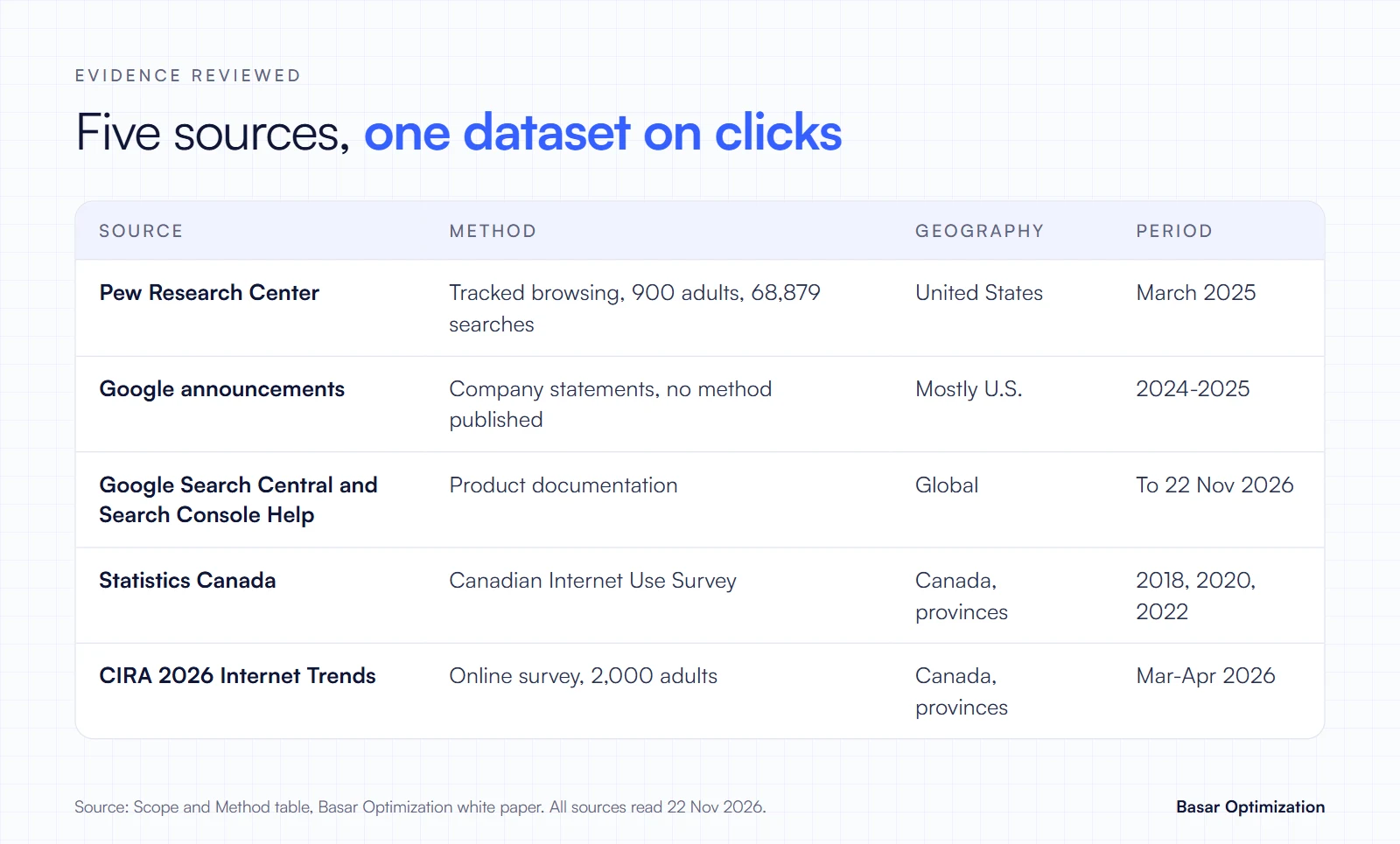
This paper reviews published evidence on Google AI Overviews and AI Mode as it stood on 2026-11-22, the date every source below was fetched and read. It deliberately excludes vendor studies, agency surveys and figures that do not state a sample, a date and a geography.
| Source | Method | Geography | Period |
|---|---|---|---|
| Pew Research Center short read, published 2025-07-22 | Tracked browsing of 900 adults on a research panel; 68,879 unique Google searches; results pages re-collected 7–17 April 2025 | United States | 1–31 March 2025 |
| Google announcements (May 2024, March 2025) | Company statements; no method published | Mostly United States | 2024–2025 |
| Google Search Central and Search Console Help | Product documentation | Global | Current to 2026-11-22 |
| Statistics Canada table 22-10-0135-01 | Canadian Internet Use Survey | Canada and provinces | 2018, 2020, 2022 |
| CIRA 2026 Internet Trends survey | Online panel survey of 2,000 adult internet users, weighted by province | Canada and provinces | March–April 2026 |
Two limits shape every conclusion that follows. No Canadian study of clicks around AI summaries was found, so the behavioural data is American. And the AI features themselves have expanded since early 2025, so the Pew figures describe a direction, not today's exact rate. The decline in Google Business Profile clicks and calls is a related but separate local-search question, covered in our earlier paper on local search in 2025; this paper concerns organic web results.
1. What Google AI Overviews and AI Mode are
An AI Overview is a summary written by a generative AI model, software that produces new text from patterns learned in training, and shown at the top of some results pages with links to the pages it drew on. Google's AI Overviews help page describes it as a snapshot of key information with links for further reading. It also warns that the summaries can contain mistakes, and it notes the feature cannot be switched off, although the "Web" filter shows text links alone.
AI Mode is a separate, conversational search experience. A searcher asks a question, receives a longer AI response with links, and can ask follow-up questions in the same thread. Google's March 2025 announcement says AI Mode runs several related searches at once across subtopics, a technique it calls query fan-out, and falls back to ordinary web results when it lacks confidence in a response.
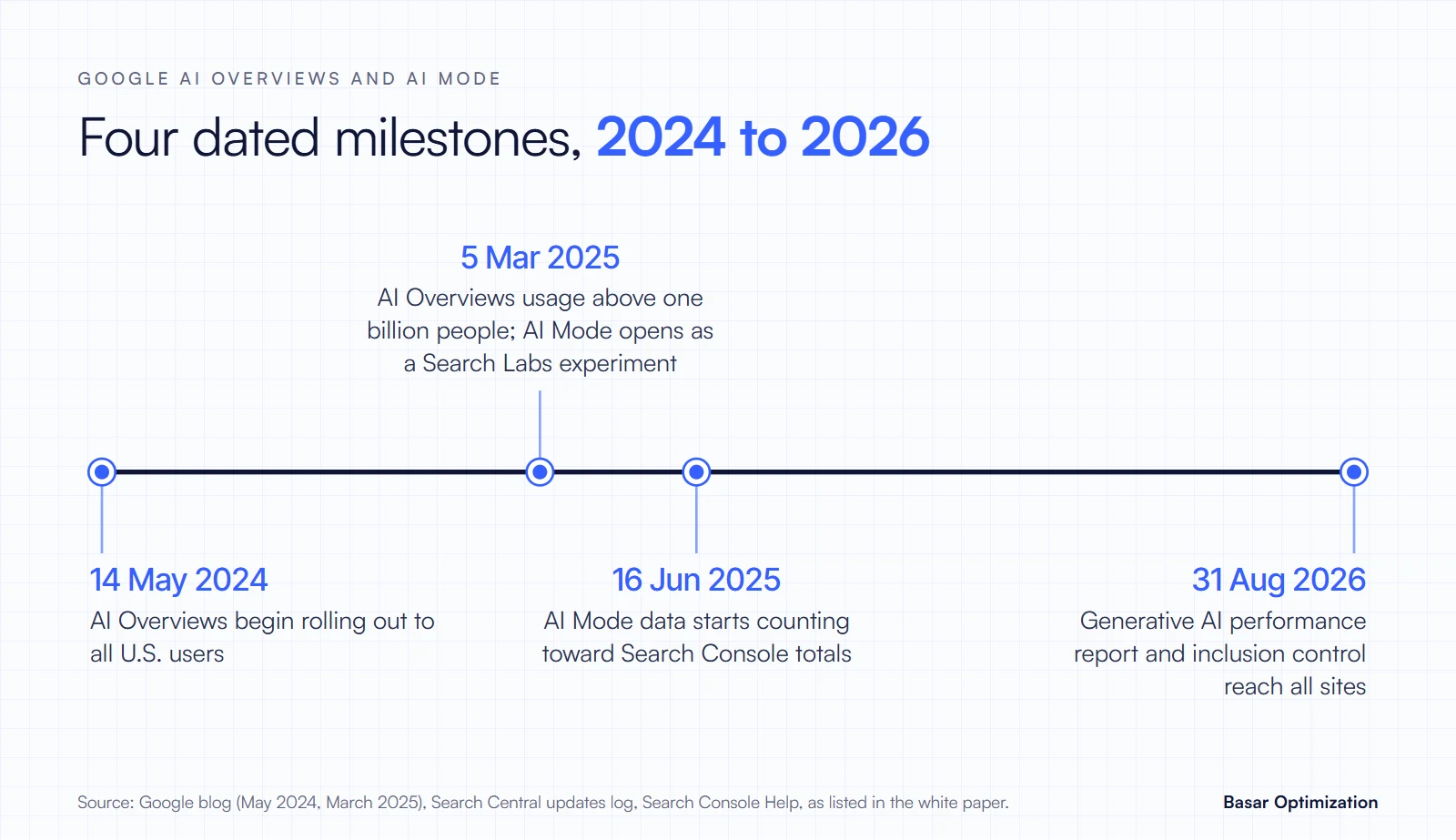
| Date | Event | Source |
|---|---|---|
| 14 May 2024 | AI Overviews begin rolling out to all U.S. users; Google expects more than a billion users by year end | Google blog |
| 5 March 2025 | Google puts AI Overviews usage above one billion people; AI Mode opens as an opt-in experiment in Search Labs | Google blog |
| 16 June 2025 | AI Mode data starts counting toward Search Console Performance totals | Search Central updates log |
| 31 August 2026 | Generative AI performance report and inclusion control rolled out to all sites | Search Console Help |
2. Observation 1: When AI summaries appear
The first question for any business is how often its customers' searches trigger a summary at all. In Pew's dataset, 12,593 of 68,879 unique searches produced one, about 18%. Most respondents met the feature at least once: 58% ran a search that month that returned a summary.
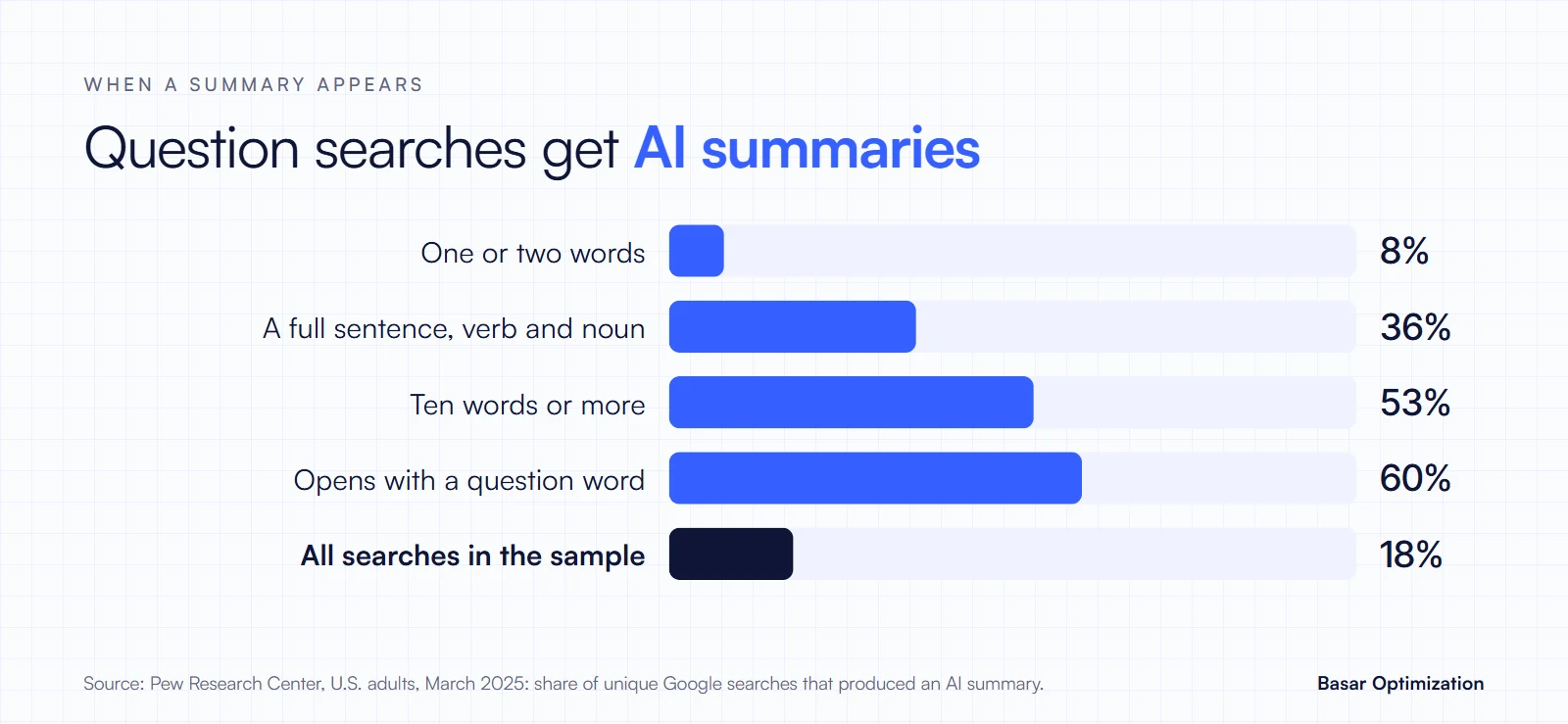
The trigger rate varied sharply with the kind of search typed. Short searches rarely produced a summary; long, question-shaped searches usually did.
| Kind of search (Pew, U.S., March 2025) | Share that produced an AI summary |
|---|---|
| One or two words | 8% |
| Ten words or more | 53% |
| Opening with a question word ("what", "why", "who", "when") | 60% |
| Written as a full sentence, with a verb as well as a noun | 36% |
| All searches in the sample | 18% |
Google's own documentation is consistent with this pattern. Its AI features guide says AI Overviews are shown only when its systems judge them additive to classic results, and that they often do not trigger. For a service business, the implication is that a short commercial search, such as a trade plus a city, is less exposed than the long research questions customers ask before they are ready to call.
3. Observation 2: What happens to clicks
A zero-click search is one that ends without the searcher visiting any website from the results page. Pew's data allows a direct comparison of behaviour on pages with and without a summary.
| Next action after the search (Pew, U.S., March 2025) | Page with AI summary | Page without |
|---|---|---|
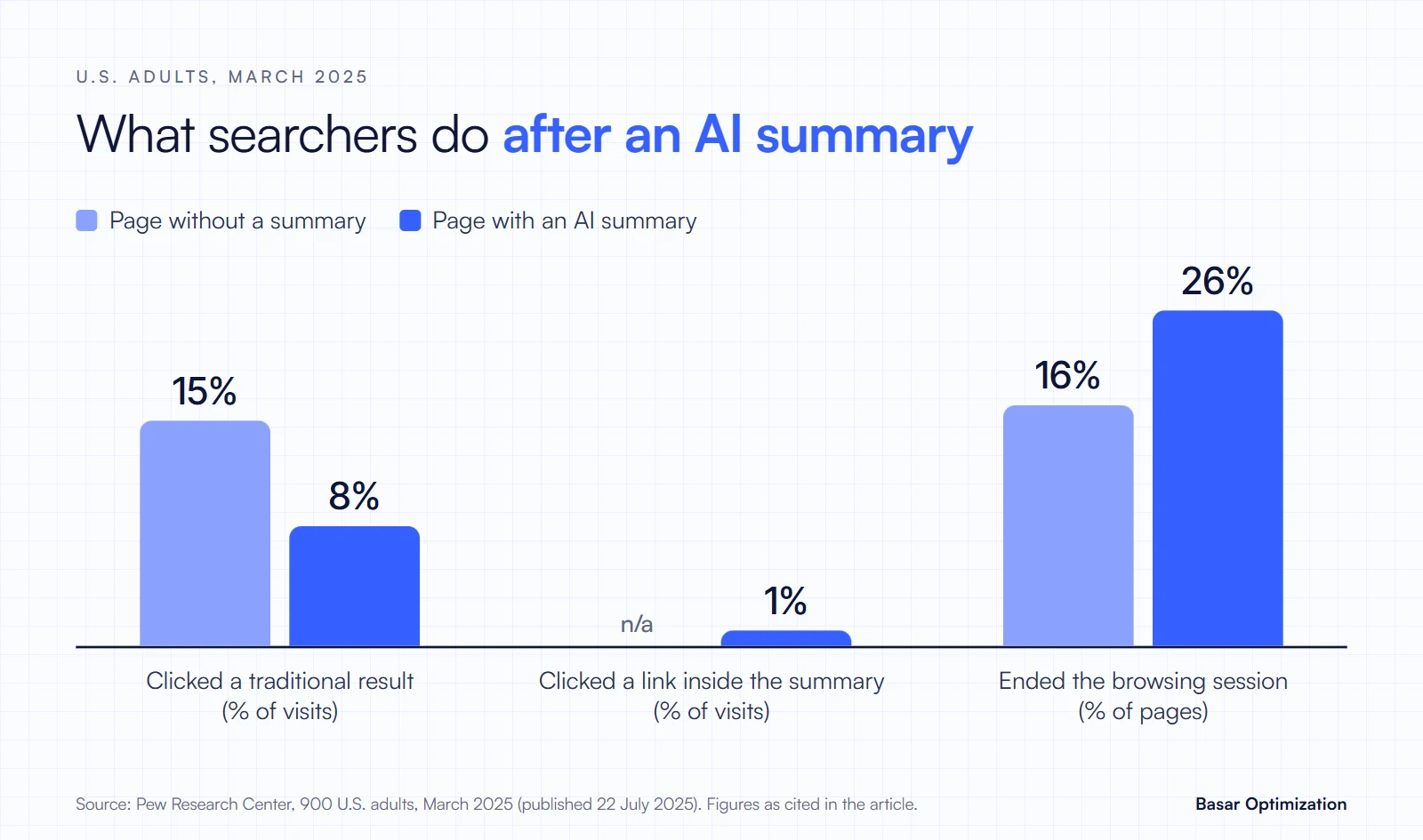
| Clicked a traditional result link | 8% of visits | 15% of visits |
| Clicked a link inside the summary | 1% of visits | not applicable |
| Ended the browsing session | 26% of pages | 16% of pages |
Three readings follow. First, a summary roughly halves the chance of a click on a traditional result in this sample. Second, the citation links inside the summary are rarely used, so being cited is closer to brand exposure than to a traffic source. Third, more searchers simply stop, which suggests the summary answered the question for many of them.
A wider point is easy to miss. Across all searches, with or without a summary, around two-thirds ended with the searcher staying on Google or leaving without clicking any result. Zero-click behaviour was already the majority pattern; summaries add to it rather than create it.
4. Observation 3: Which sources get cited
Pew also recorded the sources linked inside summaries. Most summaries were multi-source: 88% cited three or more, and only 1% cited a single page. The typical summary was short, a median of 67 words, though lengths ranged from 7 to 369 words.
The same three sites, Wikipedia, YouTube and Reddit, were the most-cited sources in both summaries and standard results, together making up 15% of summary sources and 17% of standard-result sources. Government websites were relatively more prominent in summaries, at 6% of cited sources compared with 2% in standard results. News sites held 5% in both.
For a local business, this is a sobering but useful finding. Summaries lean on large reference sources and official pages for general facts. A business page is most likely to be useful to a summary where it holds information those sources do not: its own services, service area, prices, policies and first-hand expertise. Google's guide to optimizing for generative AI features makes the same argument in its own terms, calling for "non-commodity" content that adds insight beyond common knowledge.
5. Observation 4: What Google says, and how to weigh it
Google has made three claims about the traffic effects of AI Overviews:
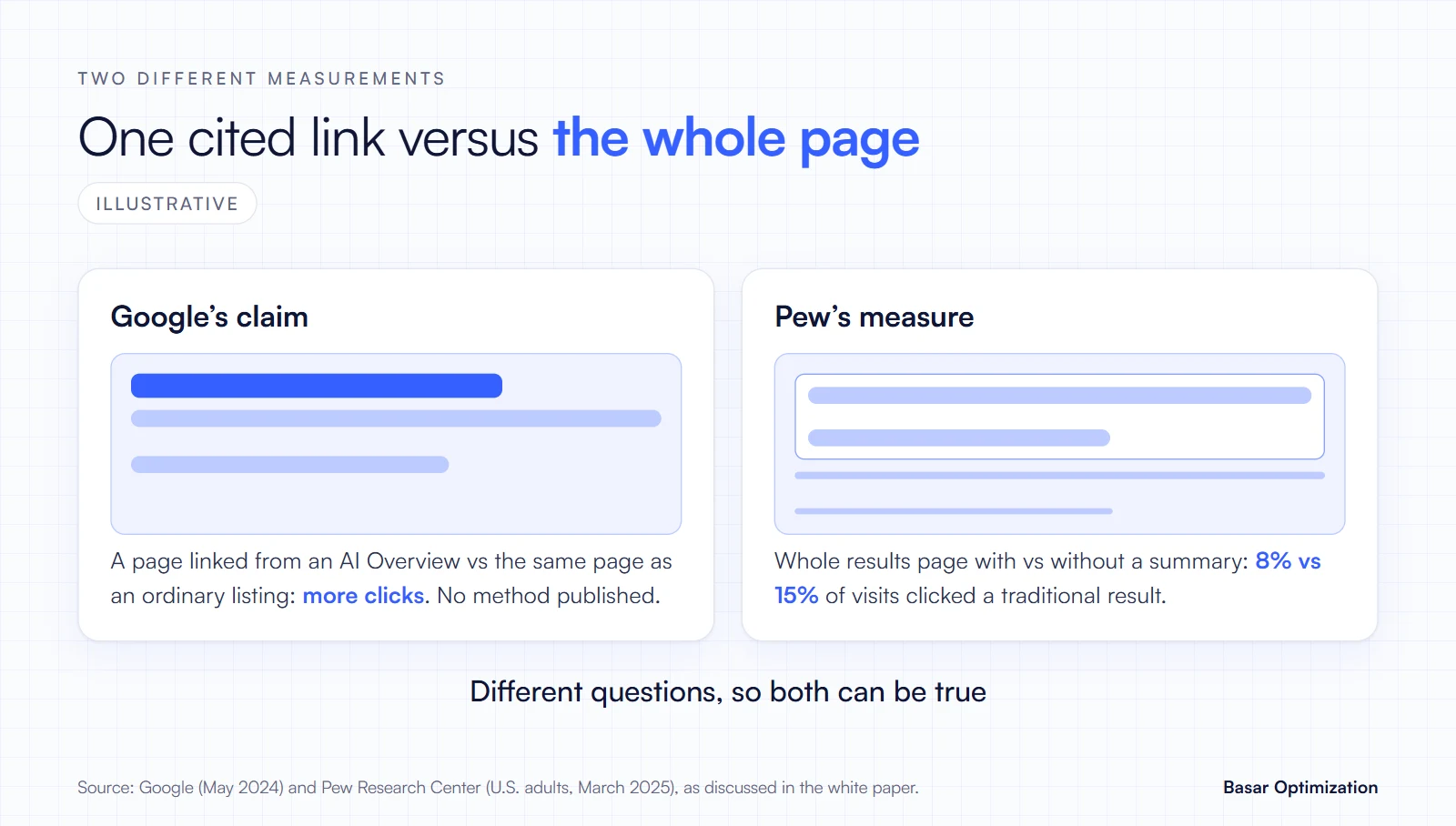
- In May 2024, that a page linked from an AI Overview attracts more clicks than it would have drawn as an ordinary listing for the same query.
- In the same announcement and again in its AI features guide, that people visit a greater diversity of websites with AI Overviews.
- In the AI features guide, that clicks from results pages with AI Overviews are higher quality, meaning visitors tend to stay longer once they arrive.
These statements are not contradicted by Pew's data so much as measured differently. Google's first claim compares a cited link with the same page as an ordinary listing; Pew compares whole pages with and without a summary. Both can be true at once: a page that is cited may do better than it would have as a lower listing, while the page of results as a whole sends fewer clicks.
The assertive position is the evidence-led one. Google's claims come without a published sample, method or period, so they cannot be checked independently. Pew's figures can, but they are one month of U.S. data. Neither should be treated as a forecast for a particular Calgary business. The reliable source for that is the business's own Search Console data.
6. Observation 5: How visibility is now counted
Measurement changed in two steps. Since June 2025, AI Mode activity has counted toward the Performance report totals in Search Console, Google's free reporting service for site owners. AI Overviews were already counted. According to Search Console's performance report help, a click on an external link in either feature counts as a click, and every link in an AI Overview is assigned the overview's single position. A follow-up question in AI Mode is treated as a new query.
The second step came on 31 August 2026, when Google rolled out two tools to all sites:
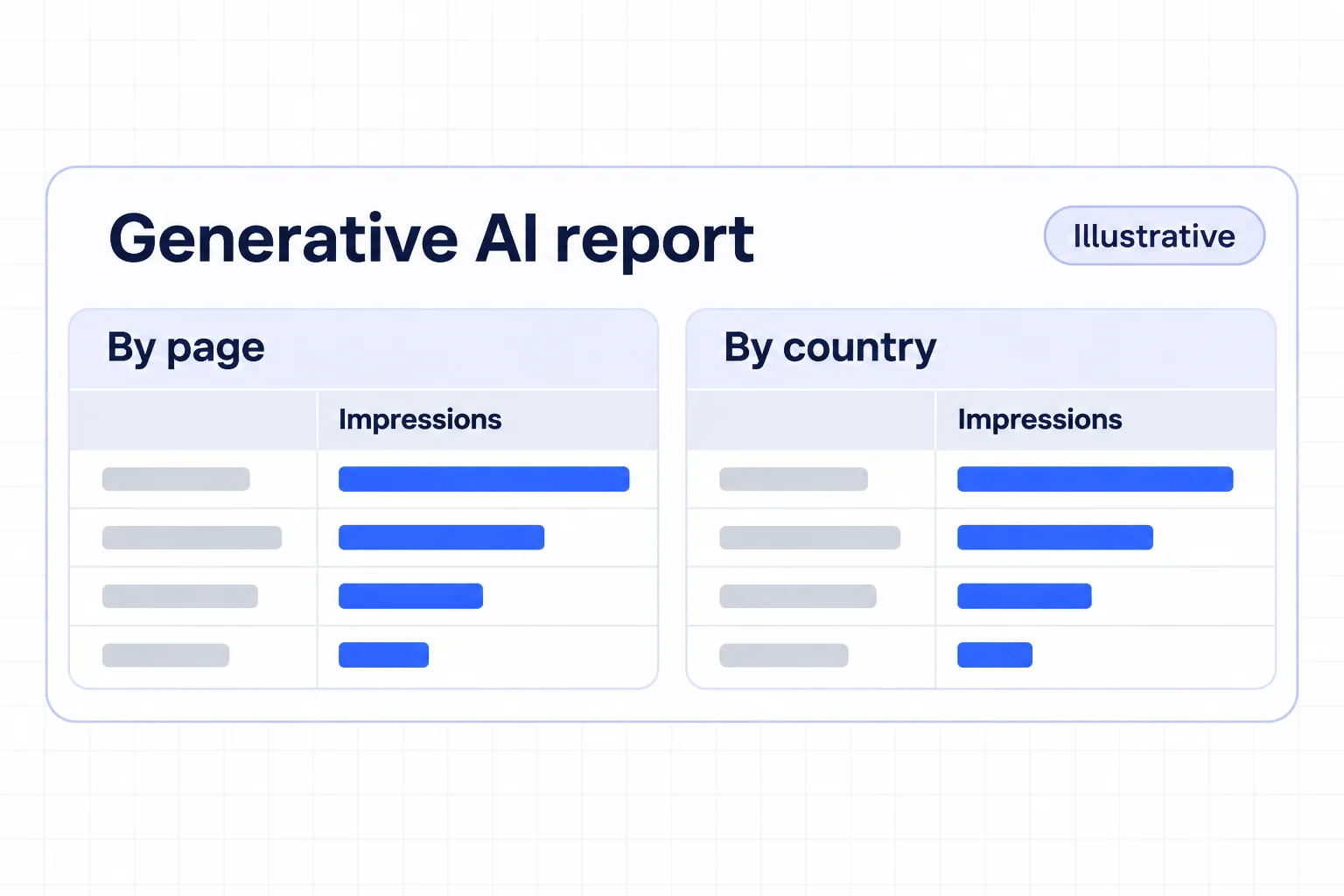
- The Generative AI performance report, which shows impressions in Search generative AI features by page, country, device and date, drawn from the "Web" search type.
- The Search generative AI control, a setting that includes a site in these features (the default) or excludes it. Google says excluding a site removes its links and content from the features and stops all traffic and impressions from them; it does not affect ranking elsewhere in Search.
The report shows impressions rather than enquiries. Search Console's data also excludes experiments in Search Labs. To connect AI-feature exposure with leads, a business still needs analytics and conversion tracking on its own site; our data-driven marketing page outlines that setup.
7. What the evidence does not tell us
A data-led paper owes its readers the gaps. Six matter here.
- No Canadian click study. Every behavioural figure above is American.
- One month, one panel. Pew's data covers March 2025 and adults on a single research panel, and its results pages were re-collected weeks later, so summaries may have differed from what users saw.
- AI Mode clicks are unmeasured independently. Pew's study covered AI summaries on standard results pages, not the AI Mode experience.
- Google's claims lack a method. The "more clicks" and "higher quality" statements cannot be reproduced.
- Local results are a separate system. Map-pack and Business Profile behaviour needs its own evidence; see the earlier local search paper.
- Sales effects are unknown. No source here measures whether fewer, possibly better-qualified visits change enquiries or sales for small businesses.
Any vendor presenting a precise figure for "traffic lost to AI Overviews" in Canada should be asked which of these gaps their data fills, and how.
8. The Canadian context
AI Overviews are available in Canada: the country appears in the availability list on Google's AI Overviews help page as fetched on 2026-11-22. The audience exposed to them is close to the whole adult population. In Statistics Canada's 2022 Canadian Internet Use Survey (table 22-10-0135-01, released 2023-07-20), 94.5% of Canadians aged 15 and over used the internet, and Alberta's rate was 95.2%. Use among Albertans aged 65 and over was 84.3%.
| Internet use, 2022 (Statistics Canada) | Canada | Alberta |
|---|---|---|
| Total, 15 years and over | 94.5% | 95.2% |
| 25 to 44 years | 99.2% | 98.4% |
| 45 to 64 years | 96.4% | 95.9% |
| 65 years and over | 82.6% | 84.3% |
These are internet-use rates, not search or AI-feature rates; they show the size of the potential audience, not how often it meets a summary.
A more recent survey shows Canadians also turning to AI tools for search. In CIRA's 2026 Internet Trends survey, an online panel conducted in March and April 2026, 46% of 2,000 adult Canadian internet users said they had used a generative AI tool in the past year, up from 16% in 2024; the Alberta figure was 45%. Among those users, 52% had used one as a search engine, against 35% in 2024. The figures are self-reported answers, not measured behaviour, and they say nothing about clicks from Google's results pages. The historical arc that led here, from ten blue links to AI answers, is traced in our review of Google search results from 1995 to 2025.
What this means for your business
The evidence supports a measured response to Google AI Overviews rather than either panic or dismissal. For a business that has already invested in SEO, the practical sequence is:
- Find your exposed queries. In Search Console, filter the Performance report for long and question-style queries; these are the searches most likely to trigger a summary.
- Check the Generative AI performance report. Note which pages already earn impressions in AI features, and confirm the inclusion control is set as you intend.
- Judge pages by enquiries, not clicks alone. If clicks fall while conversions hold, the visits that remain may be better qualified; analytics shows which.
- Publish what reference sites cannot. Prices, service areas, policies, process detail and first-hand expertise give a summary a reason to cite your page.
- Keep the foundations. Google's AI features use the same index and eligibility rules as its ordinary results, so the SEO base still matters; generative engine optimization and AI search visibility work build on it rather than replace it.
Google's documentation sets no separate requirements for "AI Overviews SEO"; on Google, the entry conditions are the SEO ones. AI SEO work starts from that base and adds what SEO reporting does not show: how a business is represented in AI answers, on Google and in other assistants.
Conclusion
The measured evidence on Google AI Overviews is narrower than the commentary around it, but it is consistent. Summaries appear on a minority of searches, cluster on long and question-style queries, cite several sources, and are associated with fewer clicks on traditional results in the independent dataset reviewed here. Google's more positive claims may hold for cited pages, but they cannot be checked. Search Console is now the place where a business can see its own position, and it is the right starting point before any strategy changes. If you would like help reading your own AI-feature and click data, you can request a quote and we will walk through it with you.
Frequently Asked Questions
Do Google AI Overviews reduce clicks to websites?
In the independent data reviewed here, yes on average. Pew Research Center found U.S. users clicked a traditional result on 8% of visits to pages with an AI summary, against 15% without one, in March 2025. Google says links cited inside AI Overviews earn more clicks than they would as ordinary listings, but it has not published a method. Your own Search Console data is the reliable test.
What is a zero-click search?
A zero-click search ends without the searcher visiting any website from the results page, either because the page answered the question or because they searched again or left. In Pew's March 2025 U.S. data, around two-thirds of all Google searches ended this way, with or without an AI summary, so the pattern predates AI Overviews.
Are Google AI Overviews available in Canada?
Yes. Canada appears in the country list on Google's AI Overviews help page, checked on 2026-11-22. Google notes the feature only appears when its systems judge a summary helpful, so many searches still show ordinary results. No Canadian study of click behaviour around AI Overviews was found, so Canadian businesses should rely on their own Search Console data.
How are AI Overviews and AI Mode counted in Search Console?
Both are counted in the Performance report's "Web" search type. A click on an external link in either feature counts as a click, and all links in one AI Overview share a single position. Since 31 August 2026, the Generative AI performance report also shows impressions in these features by page, country, device and date for every site.
Can I stop my site from appearing in AI Overviews?
Yes. Search Console's Search generative AI control lets a site owner keep the site's pages out of these AI features entirely; inclusion is the default. Google says exclusion removes all traffic and impressions from those features but does not affect ranking elsewhere in Search. Snippet controls such as nosnippet also limit what Google can show.