GEO vs SEO: Two Disciplines, Different Goals, Shared Foundations
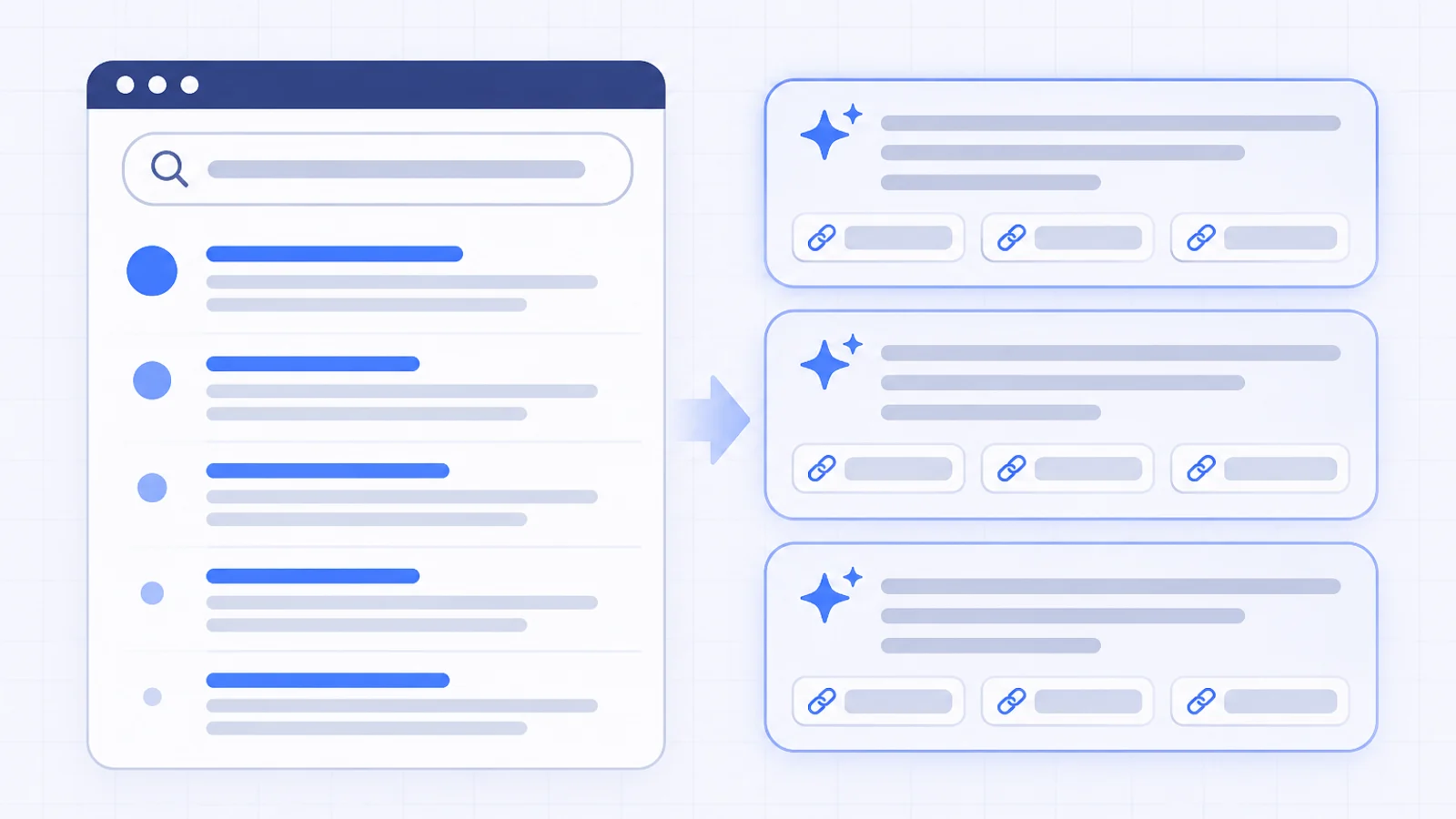
An evidence review of generative engine optimization and search engine optimization: what each discipline is trying to achieve, where their foundations overlap, and how GEO visibility is measured across AI systems.
Abstract
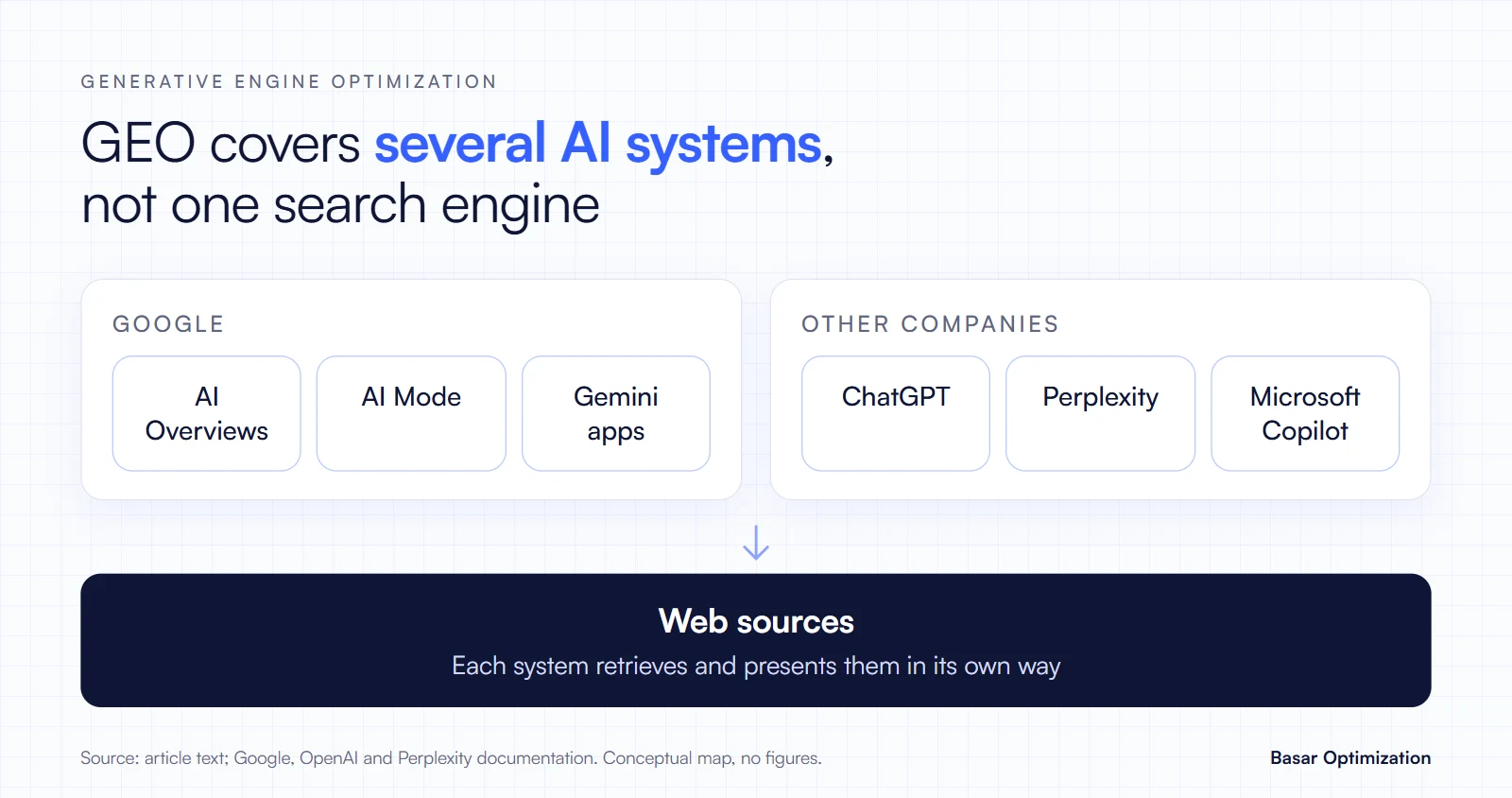
GEO vs SEO is often framed as a replacement, or as a relabelling of the same work. Both framings miss the point. Search engine optimization (SEO) works to earn rankings and clicks in search results. Generative engine optimization (GEO) works on something different: whether and how a brand, product or topic appears in AI-generated answers, how accurately it is described there, and which sources those answers cite. GEO applies across generative AI systems, not one company's products: Google AI Overviews and AI Mode, ChatGPT, Perplexity, Gemini, Microsoft Copilot and similar assistants.
The two share a foundation: pages that can be crawled and indexed, are clearly organized and carry specific, well-sourced information serve both. Above it, the goals, the unit of visibility and the measures diverge. For a business that has already invested in SEO, the conclusion is to keep that base sound, then treat representation in AI answers as its own question with its own evidence.
Scope and Method
The paper compares the disciplines on goal, visibility, systems, shared inputs, measurement and limits. Every source below was fetched and read on 2026-11-22.
- Research: Aggarwal and colleagues, "GEO: Generative Engine Optimization", published in the proceedings of the ACM SIGKDD conference in August 2024, the paper that introduced the term.
- Platform documentation: Google's AI features and your website guide and its guide to optimizing for generative AI features; OpenAI's ChatGPT search help page and crawler documentation; Perplexity's crawler documentation.
- Behavioural data: a Pew Research Center analysis of the March 2025 browsing records of 900 U.S. adults.
- Measurement documentation: Search Console Help and Google Analytics Help.
No client data, case results, vendor studies or measurement tools are used; American sources are labelled. The history of results pages is covered in our earlier paper on the evolution of Google search results from 1995 to 2025; this paper concerns practice and measurement now.
1. Definitions
Search engine optimization
SEO is the work of helping search engines discover, understand and show a site's pages for relevant searches, so that the people searching choose to visit. Google's guide to people-first content describes SEO as the set of things done specifically to help search engines discover and understand content. Its classic outcome is a position in a ranked list and the clicks that position earns.
What is generative engine optimization?
A generative engine answers in two steps, as the GEO paper describes: it retrieves a set of sources, then a large language model (software trained on very large amounts of text to predict and produce language) writes one response from them.
At Basar Optimization, we define generative engine optimization as the discipline concerned with visibility and representation in generative answers: improving whether and how a brand, product or topic appears in AI-generated responses, including the sources those responses cite. Three questions sit inside that definition. Is the business mentioned at all? Is it described accurately? Which pages, its own or other people's, does the answer rely on? The GEO paper, which coined the term, frames it from the content creator's side, as a way to improve how visible a source is inside generative answers.
Answer engine optimization (AEO) is a related discipline focused on direct answers; with crawler access work, AEO and GEO make up wider AI search optimization. AEO is covered in our explainer on AEO.
Which systems are in scope
GEO is not tied to one search engine. The systems a business may care about include Google's AI Overviews and AI Mode inside Search, Google's Gemini apps, ChatGPT with web search, Perplexity and Microsoft Copilot. Each retrieves and presents information in its own way, and the documentation shows that even one company's products differ: Google notes that AI Overviews and AI Mode may run on different models and methods, so their answers and links differ.
2. GEO vs SEO at a glance
| Criterion | SEO | GEO | Source |
|---|---|---|---|
| Goal | Earn rankings and clicks in search results | Improve whether and how a brand, product or topic appears, is represented and is cited in AI-generated answers | Google people-first content guide; Basar Optimization definition |
| Unit of visibility | A position in a ranked list | A mention, a description and a citation inside one written answer | GEO paper, section 2 |
| Systems involved | Search engines' results pages | Generative AI systems across several companies | Platform documentation |
| Shared inputs | Crawlable, indexable, clear, evidence-rich pages | The same, plus attention to how facts are worded and sourced | Google guides; GEO paper |
| Core measures | Rankings, impressions, clicks | Brand mentions, representation accuracy, citation share, sources cited, AI-referral traffic | Section 7 below |
| What neither can promise | A top ranking | A mention, citation or recommendation | Google "Do you need an SEO?"; platform documentation |
A page can rank well and still be absent from, or misdescribed in, AI answers on the same topic; a business can be named in an AI answer without its own site being the source cited.
3. Where the foundations overlap
Observation 1: Access comes first, system by system
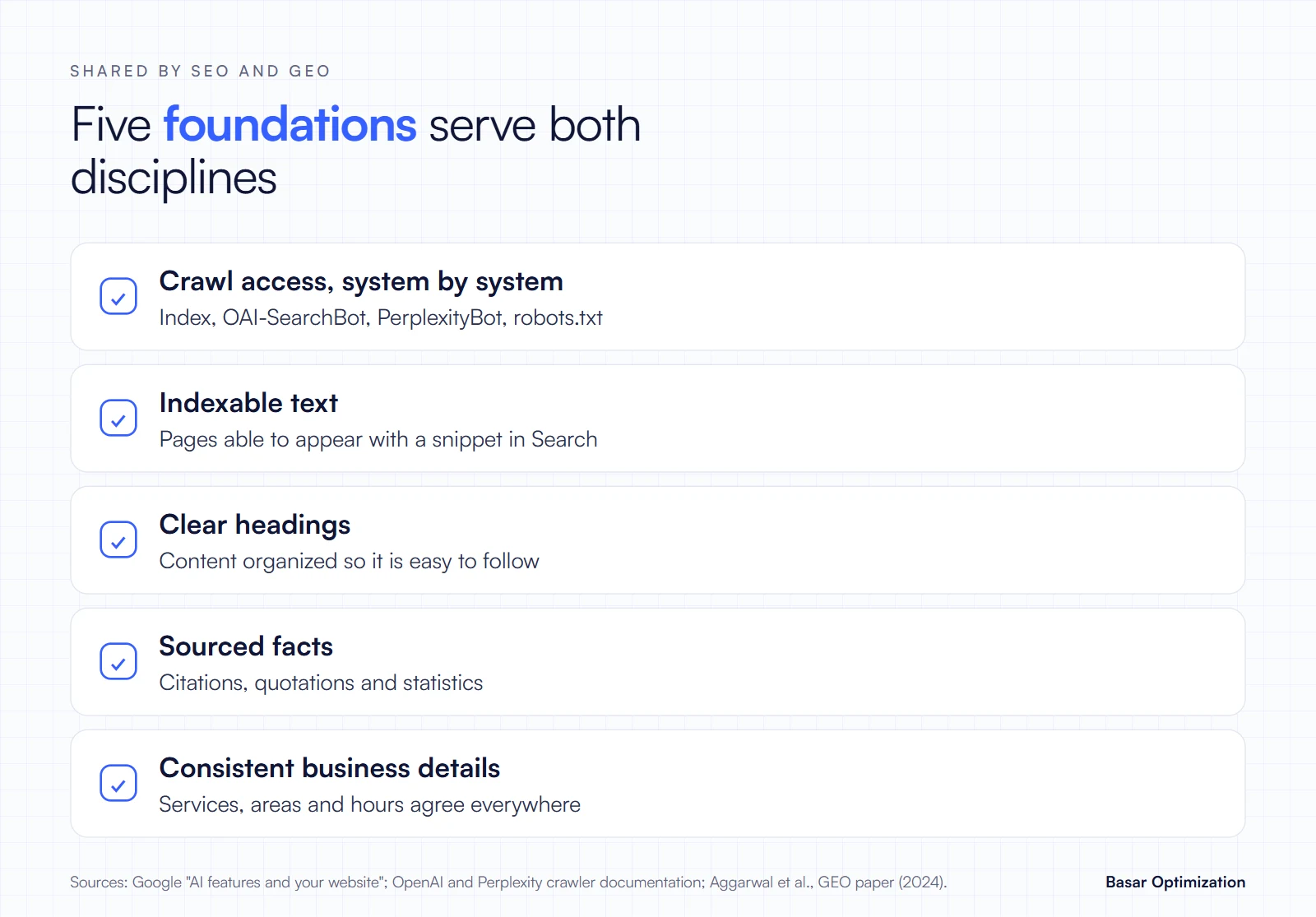
No system can use a page it cannot reach. For Google's AI features, the AI features guide sets the condition: a page has to be in the index and able to appear with a snippet in ordinary Search. The other assistants publish their own conditions. OpenAI's help page says that to be eligible for ChatGPT search results, a site should allow the OAI-SearchBot crawler, and its host or content delivery network should accept traffic from OpenAI's published addresses. Perplexity's documentation recommends allowing PerplexityBot, the crawler it uses to find and link sites in its search answers.
The foundation is shared but not a single switch. Crawl access, hosting rules and robots.txt directives (the file that tells crawlers which URLs they may fetch) have to be right for each system a business wants to appear in. That technical review is the subject of our LLM crawler optimization work.
Observation 2: Clear, specific, well-sourced content serves both
Both bodies of evidence point the same way. Google's optimization guide asks for "non-commodity" content, meaning material with first-hand or expert insight that goes beyond common knowledge, organized under headings that make it easy to follow. The GEO paper found that adding citations, quotations and statistics to a page raised its visibility in generated answers, and that improving fluency and readability helped too. Google also warns that producing a separate page for every variation of a question, mainly to manipulate results, breaches its scaled content abuse policy: volume is not the goal.
Observation 3: Accurate business facts are an input everywhere
An AI answer about a business is only as accurate as its inputs. Google's AI features guide lists keeping Business Profile and Merchant Center details up to date among its fundamentals. For GEO the point is broader: services, service areas, hours and other facts should agree across the website and the profiles that AI systems may read.
4. Where the disciplines diverge
Observation 4: Visibility becomes representation, not rank
In a ranked list, visibility is a number: position three is position three. In a generated answer, several sources are blended into one response, and a business can be named first, described in detail, reduced to a passing reference or left out. The GEO paper's authors made this point directly, arguing that simple ranking metrics do not carry over to generative responses, and built new measures instead: one weights how many words of the answer draw on a source and where its citation sits, the other uses a model to judge how prominent and relevant the source appears.
GEO therefore asks a question SEO does not: when an answer mentions you, what does it say?
Observation 5: Accuracy is part of the outcome
A search result points to the page itself; a generated answer paraphrases it. The platforms warn about the consequence themselves. Google's AI Overviews help page cautions that AI responses may include mistakes, and OpenAI's ChatGPT search help warns that its search results and citations may be out of date, incomplete or wrong. An answer that names a business with the wrong service area or an outdated offer is a visibility problem of its own, so checking representation accuracy is part of GEO's work. Research points the same way: a survey of the field by Huang and colleagues (arXiv 2311.05232) finds large language models prone to plausible but nonfactual output, a reliability problem for any system people use to find information.
Observation 6: Evidence and presentation helped in the lab, keyword habits did not
The GEO paper tested nine ways of rewriting source pages against GEO-bench, a 10,000-query benchmark it built, using a generative engine the authors assembled, and then repeated the tests on one commercial engine.
| Method tested | Reported effect on visibility | Source |
|---|---|---|
| Cite Sources, Quotation Addition, Statistics Addition | Top performers: 30–40% relative improvement on the word-count-and-position metric, 15–30% on the subjective impression metric | GEO paper, section 4 |
| Fluency Optimization, Easy-to-Understand | A 15–30% lift: presentation mattered, not only substance | GEO paper, section 4 |
| Authoritative (more persuasive tone) | No significant improvement overall | GEO paper, section 4 |
| Keyword Stuffing | Little to no improvement | GEO paper, section 4 |
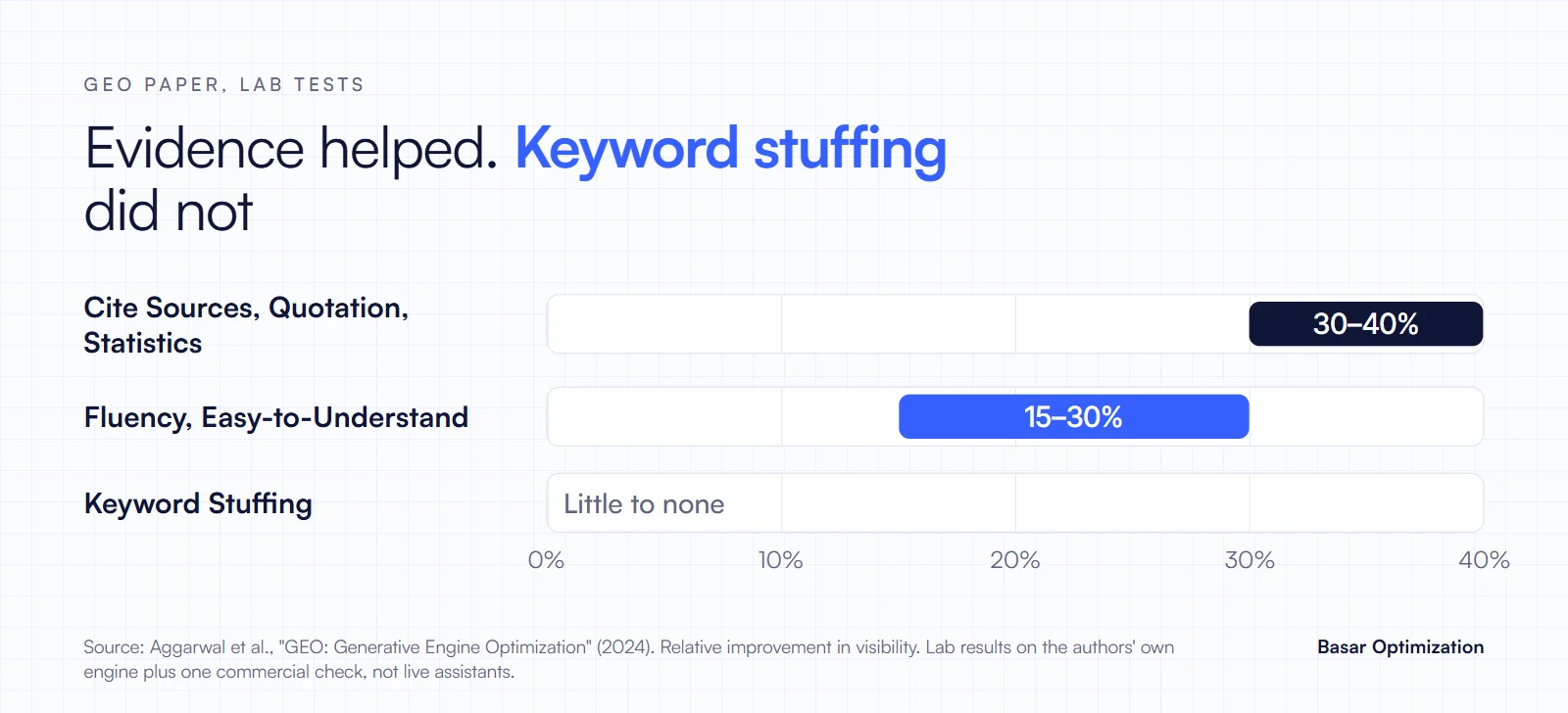
Stating facts with numbers, attributing them to credible sources and explaining them plainly made a page more likely to be drawn on. Repeating keywords, a habit carried over from early SEO, did not.
Observation 7: Fewer clicks raise the value of being named
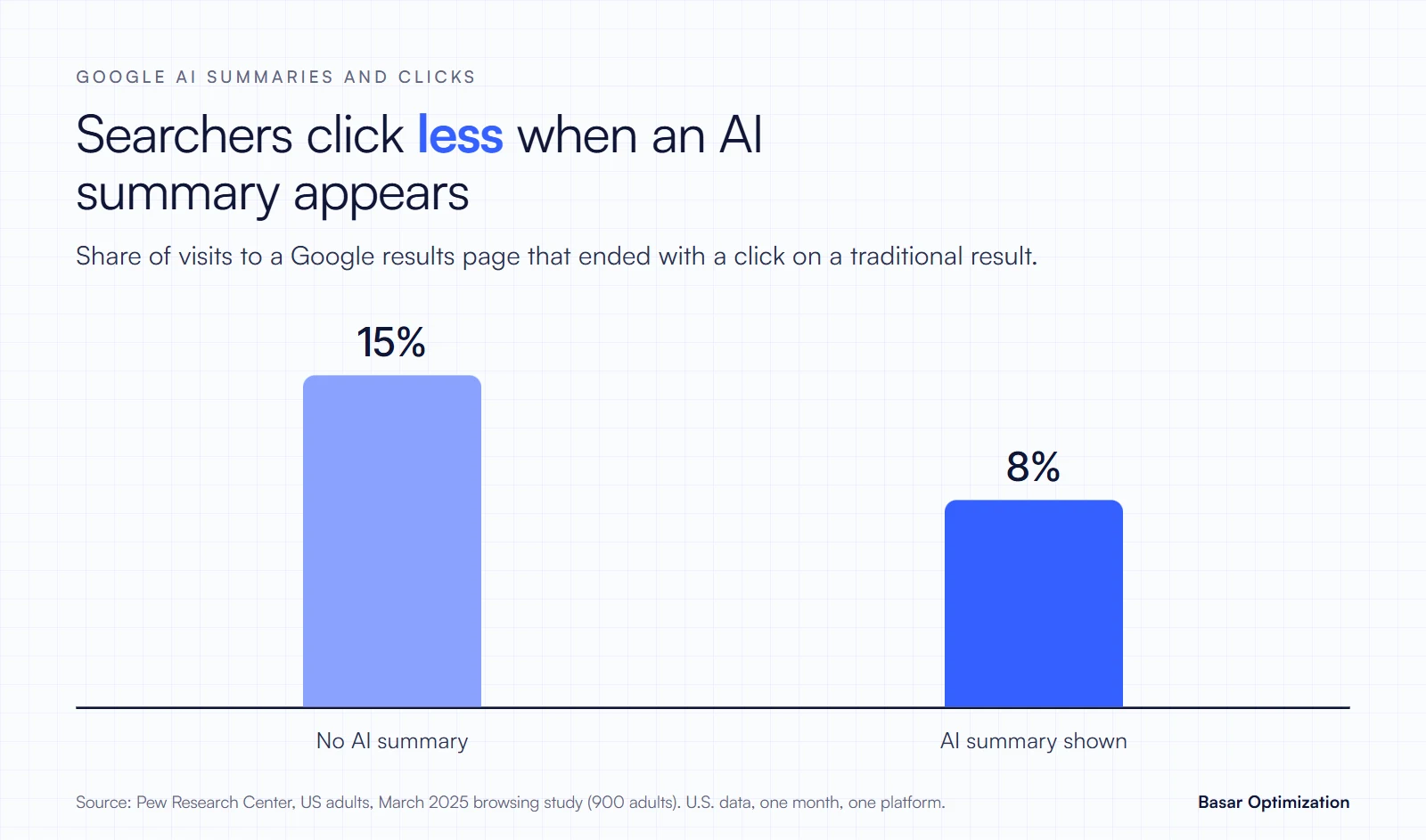
This matters commercially. In Pew Research Center's sample of 900 U.S. adults in March 2025, people who saw an AI summary on Google clicked a traditional result on 8% of visits, compared with 15% for people who saw none, and clicked a link inside the summary on 1% of visits. These are U.S. figures from one month on one platform, so they show a direction, not a Canadian rate: when an answer is complete enough, the mention inside it may be the only exposure a business gets.
5. Google's position, and why it is not the whole picture
Google has stated its own view of these labels. Its guide to optimizing for generative AI features, last updated on 2026-07-10, says that, as Google Search sees it, work aimed at its generative AI search features is search optimization, and so still SEO. That is a reasonable statement about Google's products, and consistent with the shared foundations above. It also has a defined scope. It speaks for Google Search, not for ChatGPT, Perplexity or Copilot, each of which runs its own crawler, retrieval and presentation. Even within Google, the company manages Gemini apps separately: its crawler documentation describes Google-Extended as a control over the use of site content for training and grounding in Gemini apps, with no effect on inclusion or ranking in Search. Google's view is therefore best read as Google's account of its own features, not as a definition of GEO.
6. What the research does not show
Five limits apply.
- The lab is not production. The GEO paper's main engine was built by its authors and fed the top five Google results per query; the commercial engine was a single check. Live assistants use their own models and retrieval.
- Top-ranked sources lost ground. In the paper's Table 2, Cite Sources lifted a fifth-ranked source by 115.1% while the visibility of the first-ranked source fell by 30.3%. A business already ranking first has no evidence that GEO-style rewriting helps it.
- Rankings were not measured. The authors state that they did not test how their methods affect search rankings.
- Engines change. The paper's limitations section expects methods to need adapting as generative engines evolve.
- No timeframe exists. Neither the platforms nor the paper publish a period within which AI visibility should appear.
7. How GEO is measured
SEO has mature, first-party measures: rankings, impressions and clicks, largely reported in Search Console. GEO's measures are mostly gathered rather than downloaded. Answers vary by platform, by how a question is worded and over time, so the method should be agreed before monitoring begins and kept stable so that results can be compared.
| Measure | What it records | How it is gathered | Main limit |
|---|---|---|---|
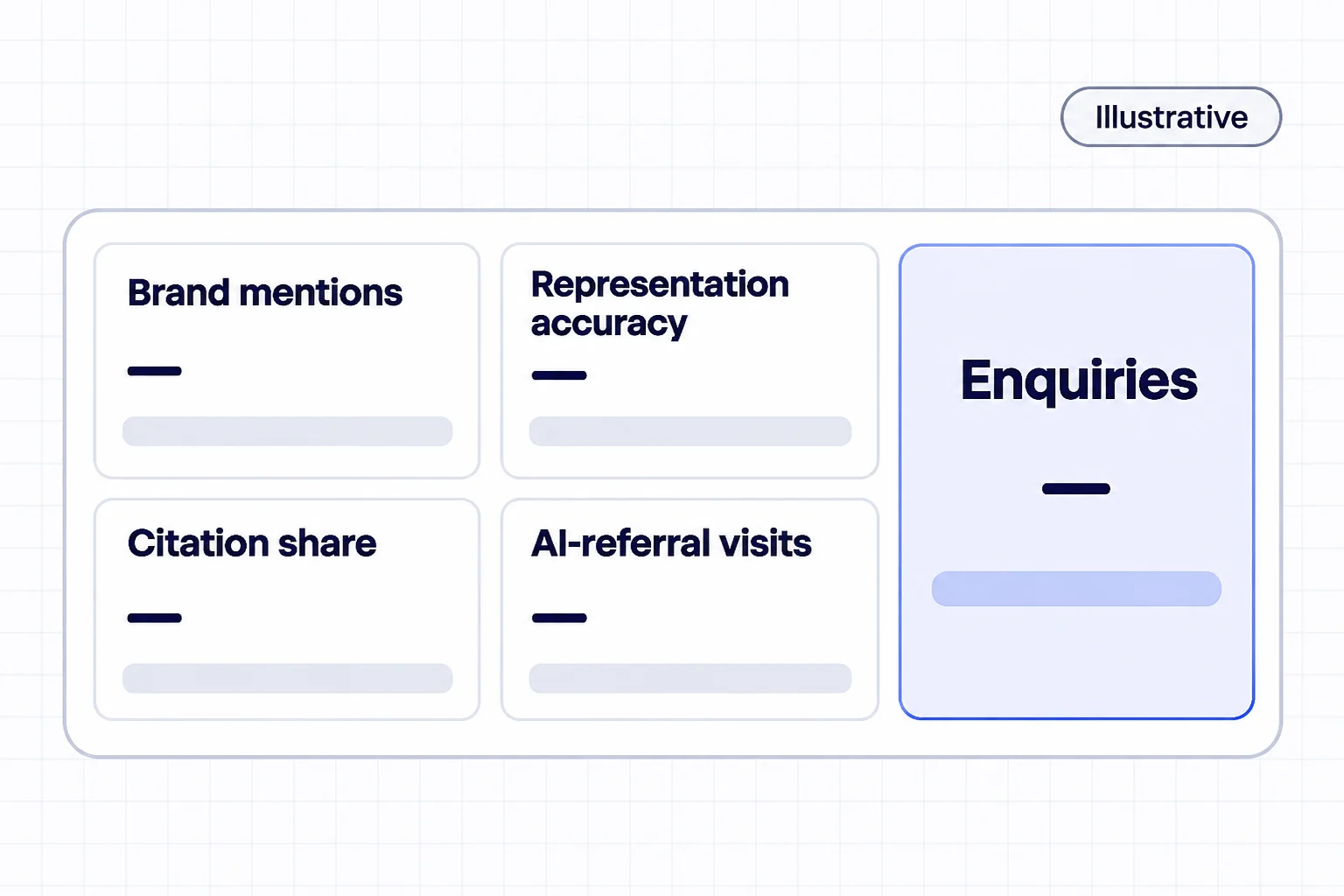
| Brand mentions | Whether the business appears in answers to a defined set of customer questions | Sampling selected platforms with an agreed list of prompts, repeated on a schedule | A sample, not a census; answers change |
| Representation accuracy | Whether services, locations and other details are described correctly | Reading sampled answers against the business's own confirmed facts | Requires judgement and a reference set of facts |
| Citation share | How often the business's own pages are among the sources an answer cites | Counting citations across the sampled answers | Only visible where a platform displays its sources |
| Sources cited | Which pages, including third-party pages, the answers rely on | Recording the cited URLs and their owners | Shows where information comes from, not why it was chosen |
| AI-referral traffic | Visits that arrive from AI assistants | Google Analytics' Session source dimension, which records the site that referred a session | Some visits may arrive without identifiable referral data |
| Google AI-feature impressions | Impressions in Google's generative AI features by page, country, device and date | Search Console's Generative AI performance report, rolled out to all sites on 2026-08-31 | Covers Google only; impressions, not enquiries |
| Enquiries | Calls, forms and quote requests | Conversion tracking on the business's own site | Linking an enquiry to an AI answer may need extra source information |
Pew's data illustrates the "sources cited" measure at scale: in its U.S. sample, a few very large reference, video and forum sites were the most-cited sources in Google's AI summaries, and government sites took a larger share of summary citations than of standard results. For one business, the same exercise shows which directories, reviews or articles assistants lean on, and so where wrong information needs correcting.
Two cautions apply. No platform publishes a cross-assistant visibility report, so any "AI visibility" figure depends on the prompts, platforms and dates sampled. And a mention is a discovery signal, not proof of a sale. The measures that matter to a business are still calls, forms and quote requests, which is why our AI search visibility reporting sits beside data-driven marketing and lead tracking.
What this means for your business
For an established Calgary business that has already invested in SEO, six steps follow, in order:
- Confirm the shared foundations. Check that key pages are indexed, crawlable and linked internally; our SEO services overview lists what that audit covers.
- Check access for each AI system you care about. Review robots.txt and hosting rules for the crawlers named in each platform's documentation.
- Write down the facts you want represented. List services, service areas, hours and key details, and make them consistent across the website and business profiles.
- Present evidence plainly. Add sourced figures and clear explanations to the pages that answer customers' real questions, and cover likely follow-up questions on the same page rather than in thin duplicates.
- Set a GEO baseline. Agree a prompt list and platforms, then record mentions, accuracy, citations and cited sources before changing anything, so later results can be compared.
- Connect visibility to enquiries. Track AI-referral visits and conversions so that generative engine optimization work is judged by leads, not by mentions alone.
Related work on direct answers sits on our answer engine optimization page.
Conclusion
GEO vs SEO is a comparison of two disciplines with different goals. SEO earns rankings and clicks in search results. GEO works on whether and how a business appears in AI-generated answers across many systems, how accurately those answers describe it and which sources they cite. The two share a foundation of accessible, clear and well-sourced pages, so GEO works alongside SEO rather than replacing it. Google's view that optimizing for its own AI features is SEO describes Google's products; it does not settle the question for ChatGPT, Perplexity, Copilot or the next assistant. If you would like a second opinion on how your business currently appears in AI answers, you can request a quote and we will review it with you.
Frequently Asked Questions
What is the difference between GEO and SEO?
SEO aims to earn rankings and clicks in search results. GEO aims to improve whether and how a brand, product or topic appears in AI-generated answers, how accurately it is described and which sources are cited. Both rest on crawlable, clear, well-sourced pages, but they pursue different outcomes and use different measures.
Is GEO just SEO for Google?
No. GEO covers generative AI systems from several companies, including Google AI Overviews and AI Mode, ChatGPT, Perplexity, Gemini and Copilot. Google says that, from its own Search perspective, optimizing for its generative AI features is still SEO. That is Google's view of its own products, and it does not describe how other assistants select and present sources.
Does GEO replace SEO?
No. A business still needs pages that can be crawled, indexed and understood, and that foundation serves both disciplines. GEO adds work that SEO does not cover: checking whether AI answers mention the business, whether they describe it accurately and which sources they rely on, then improving the information behind those answers.
How is GEO measured?
GEO is measured by sampling answers on selected AI platforms with an agreed list of customer questions, then recording brand mentions, representation accuracy, citation share and the sources cited. AI-referral visits can be tracked in analytics, and Google's Generative AI performance report covers Google's features. Enquiries such as calls, forms and quote requests show business impact.
Can anyone guarantee my business will appear in AI answers?
No. Each AI platform decides which sources to use and how to present its answers, and those answers vary by question and over time. GEO can improve the clarity, accuracy and accessibility of the information about a business, but it cannot guarantee a mention, citation or recommendation. Treat any such guarantee as a warning sign.