What Is AEO? How Answer Engines Choose Sources, Explained for Business Owners

What is AEO? AEO, short for answer engine optimization, is the practice of shaping a website's content so that search systems which reply with a direct answer, rather than a list of links, choose that site as a source. On Google, that answer can be a featured snippet, an AI Overview or a response in AI Mode; assistants such as ChatGPT and Perplexity also answer directly and cite their sources.
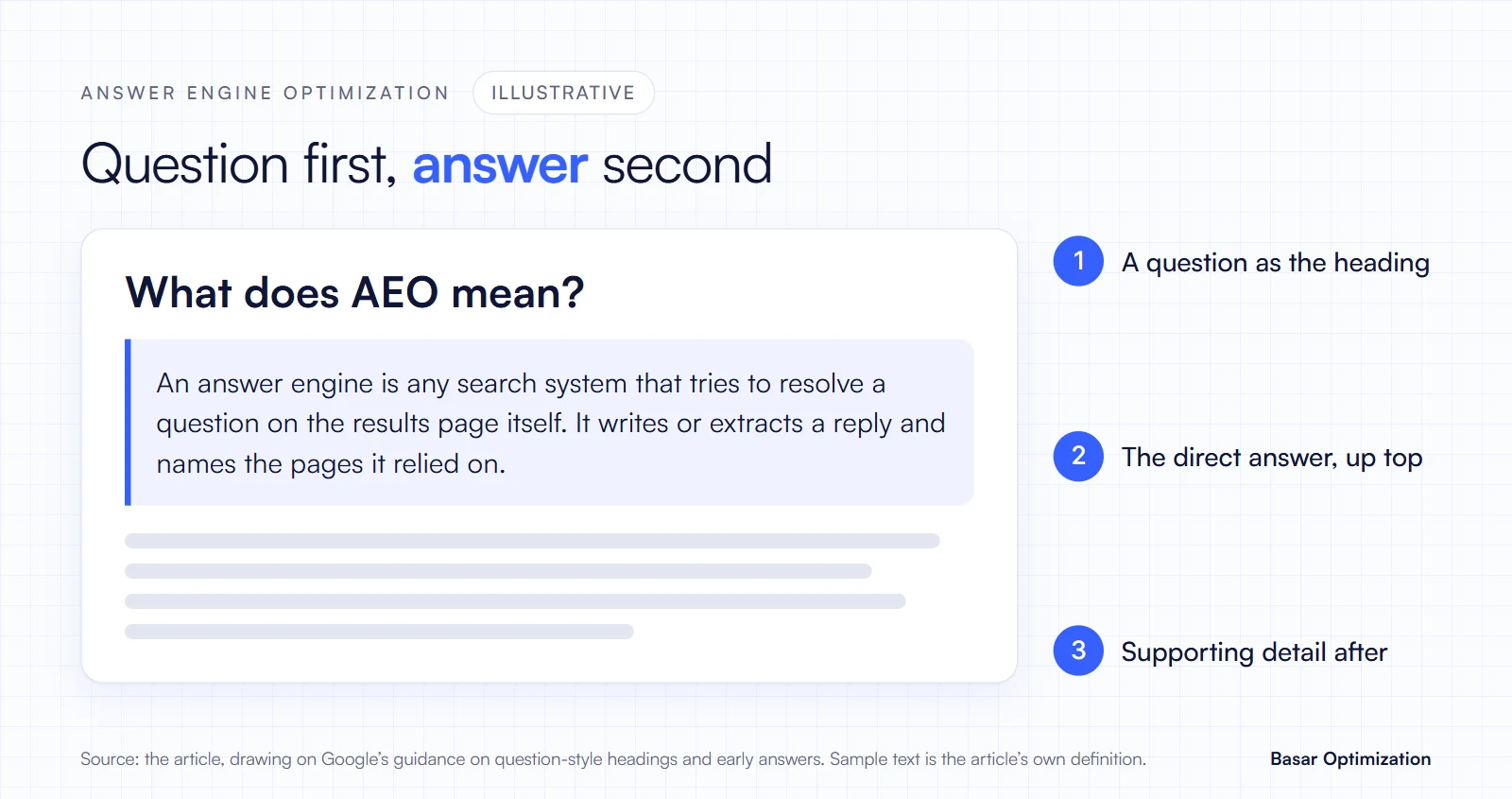
What does AEO mean?
An answer engine is any search system that tries to resolve a question on the results page itself. Instead of handing over ten links, it writes or extracts a reply and names the pages it relied on. AEO is the effort to be one of those named pages. Canadians already search this way: in CIRA's 2026 survey of 2,000 adult internet users, 46% had used a generative AI tool in the past year, and 52% of those users had used one as a search engine.
No standards body defines the term, so its meaning varies by provider. Google acknowledges the label in its guide to optimizing for generative AI features, describing AEO and GEO (generative engine optimization) as names people use for work aimed at visibility in AI search. That guide was last updated in July 2026.
AEO vs SEO: how do they differ?
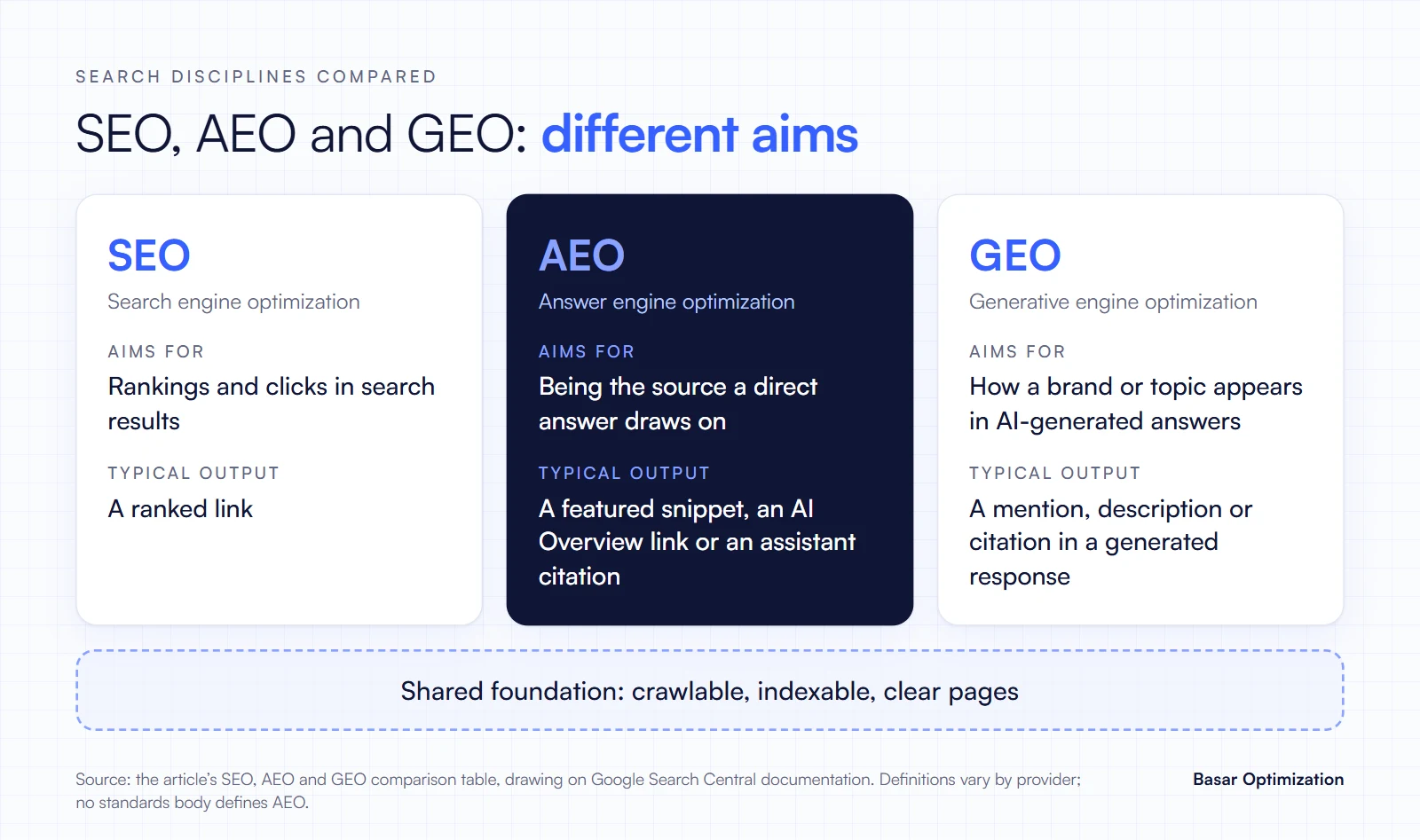
They differ in goal and share a foundation. SEO works to earn rankings and clicks in search results; AEO works to make a business's information the source a direct answer uses. The foundation is common: on Google, a page has to be indexed and able to show a snippet before an AI Overview or AI Mode can link to it, according to the AI features guide. Google's own view, for its Search features, is that optimizing for its generative AI results is still SEO; that is Google's account of its products, not a definition of AEO.
| Discipline | What it aims for | Typical output | Relationship to the others |
|---|---|---|---|
| SEO (search engine optimization) | Rankings and clicks in search results | A ranked link | The shared foundation: crawlable, indexable, clear pages |
| AEO (answer engine optimization) | Being the source a direct answer draws on | A featured snippet, a cited AI Overview link, an AI Mode or assistant citation | Its own focus on direct-answer formats, built on that foundation |
| GEO (generative engine optimization) | Whether and how a brand, product or topic appears in AI-generated answers, including the sources cited | A mention, description or citation in a generated response, across AI systems | Its own discipline, built on the same foundation and overlapping with AEO |
The AEO vs SEO question therefore has a practical answer: keep the SEO foundation, then make sure the pages customers' questions reach answer them clearly.
Where can a business appear as the answer?
Four Google answer formats matter to a small or medium business:
- Featured snippets. A featured snippet is a result that shows an extract from a page first and the link second. Google's featured snippets documentation says these can also appear inside "People Also Ask".
- People Also Ask. An expandable block of related questions; because featured snippets can sit inside it, a page that answers a related question clearly can surface there too.
- AI Overviews. An AI-written summary at the top of some results pages, with links to the pages it drew on. Google's AI Overviews help page lists Canada among the countries where the feature is available.
- AI Mode. A conversational search experience where follow-up questions continue the thread and responses carry links to supporting pages.
Our paper on the evolution of Google search results traces how these formats arrived.
What helps a page become the answer?
Google's guidance points to a short list of practices that apply across all four formats.
- Answer the question early. State the direct answer near the top of the section that covers it, then explain. Summaries cluster on questions: in Pew Research Center's March 2025 data from 900 U.S. adults, 60% of Google searches opening with a question word produced an AI summary.
- Use headings that match real questions. Clear sections help readers and let systems find the relevant passage; Google says its systems can understand several topics on one page.
- Say something others cannot. Google's AI optimization guide calls for "non-commodity" content, material with first-hand or expert insight that goes beyond common knowledge. Evidence helps too: in lab tests published at KDD 2024, adding citations, quotations or statistics raised a source's visibility in generated answers by 30–40% on one measure.
- Keep the technical basics sound. Pages must be crawlable and indexed; internal links help them be found.
- Keep business facts accurate. Google lists an up-to-date Business Profile among the fundamentals for its AI features, so hours, services and areas served should match the website.
- Use structured data honestly. Structured data is code that labels a page's content for search engines. Google's introduction to structured data warns against marking up anything that is not visible to the visitor.
What AEO cannot do
It cannot select the snippet. Google's featured snippets documentation is blunt: a site owner cannot mark a page as a featured snippet. Google's systems decide; owners can only opt out with snippet controls.
Google does not require special files or markup. Google states that no special schema.org markup or AI text file is required for its AI features. Its optimization guide also lists breaking content into tiny "chunks" and rewriting copy solely for AI systems among tactics a site owner can ignore for Google Search.
FAQ markup no longer earns a rich result. Google's documentation updates log records that the FAQ rich result stopped appearing in Google Search from 7 May 2026, and the documentation for it was removed on 15 June 2026.
It cannot be guaranteed. Google's AI features guide notes that meeting every requirement still does not guarantee a page will be crawled, indexed or shown. Google's guidance on third-party SEO advice adds that tools promising AEO or GEO improvements have no access to its internal ranking data.
How do you measure it?
For Google's formats, measurement starts in Search Console, Google's free reporting tool for site owners. Activity in AI Overviews and AI Mode is counted inside the Performance report's "Web" search type. Since 31 August 2026, the Generative AI performance report has also shown impressions in these features by page, country and device for every site.
Impressions are the right first signal, because a cited answer may be read without a click; in Pew's U.S. data, links inside an AI summary were clicked on 1% of visits. Other assistants publish no equivalent report, so their answers are sampled. Pair both with enquiries tracked in analytics before deciding whether the effort is paying off.
Final Thoughts
AEO is the discipline of making a business's information the answer that direct-answer systems choose. The evidence-led approach is to keep the SEO foundations, make sure the pages that customers' questions reach give clear and original answers, and measure appearances with first-party data alongside tracked enquiries. Related services sit on our answer engine optimization, generative engine optimization and AI SEO pages, all built on the same search optimization base. If you would like a view on which of your pages already answer customers' questions well, you can request a quote and we will go through them with you.
Frequently Asked Questions
What is AEO in simple terms?
AEO, answer engine optimization, means making a website easy for search systems to use as the source of a direct answer. On Google that answer may be a featured snippet, an AI Overview or an AI Mode response. In practice it involves answering questions clearly, publishing original information and keeping the technical SEO basics sound.
What is the difference between AEO and SEO?
SEO aims to earn rankings and clicks in search results. AEO aims to make a page the source a direct answer relies on, on Google and in other AI assistants. The two share a foundation and can support the same content strategy. Google says optimizing for its own generative AI features is still SEO; that is Google's view of its products.
Do I need FAQ schema for AEO?
No. Google states that no special schema.org markup is needed for its AI features, and the FAQ rich result stopped appearing in Google Search in May 2026. FAQ structured data can still describe a page accurately if it matches the visible questions and answers, but it should not be presented as a way to win extra space on Google's results page.
Can I choose which text Google shows as a featured snippet?
No. Google's documentation says site owners cannot mark a page as a featured snippet; its systems decide which page and passage to show. Owners can only opt out, by using the nosnippet rule or lowering max-snippet. Clear headings and a direct answer near the top of a section make a passage easier to extract.