Is SEO Still Relevant? What Calgary Businesses Should Know Heading Into 2027

Is SEO still relevant now that AI-generated answers sit above the links? Yes, but the evidence changes what "working" means: fewer clicks per search on some queries, the same fundamentals for appearing at all, and more weight on being the source an answer cites. For most established local businesses with real search demand, search engine optimization remains worth doing; for a few, it is not, and the difference can be checked.
Why the Question "Is SEO Dead?" Keeps Coming Back
Search engine optimization (SEO) is the work of making a website easy for search engines to find, understand and show, and worth choosing once people see it. Every major change to the results page revives the claim that SEO is dead. The current version is driven by AI Overviews, the AI-generated summaries Google shows above many results, and by AI Mode, its conversational search experience.
The claim mixes two questions: whether search still sends customers to businesses, and whether measuring success by clicks alone still holds. The five myths below separate them, each tested against a published source.
Myth 1: AI Answers Have Killed Search Clicks
The best public evidence shows fewer clicks, not none. Pew Research Center analyzed the March 2025 browsing of 900 U.S. adults and found that people clicked a traditional result in 8% of visits to a Google results page that showed an AI summary, against 15% when no summary appeared (Pew Research Center, July 2025). Clicks on links inside the summary itself were rare, at 1% of those visits.
Two limits matter: the data is American, not Canadian, and covers one month. Pew also found only about 18% of searches in its sample produced a summary, far more often on long, question-style searches than on short ones.
The reasonable reading is that pages shown beside an AI summary earn fewer clicks per search, while being cited and visible still matters: a change in the return on SEO, not its end.
Myth 2: AI Search Needs a Completely Different Kind of Optimization
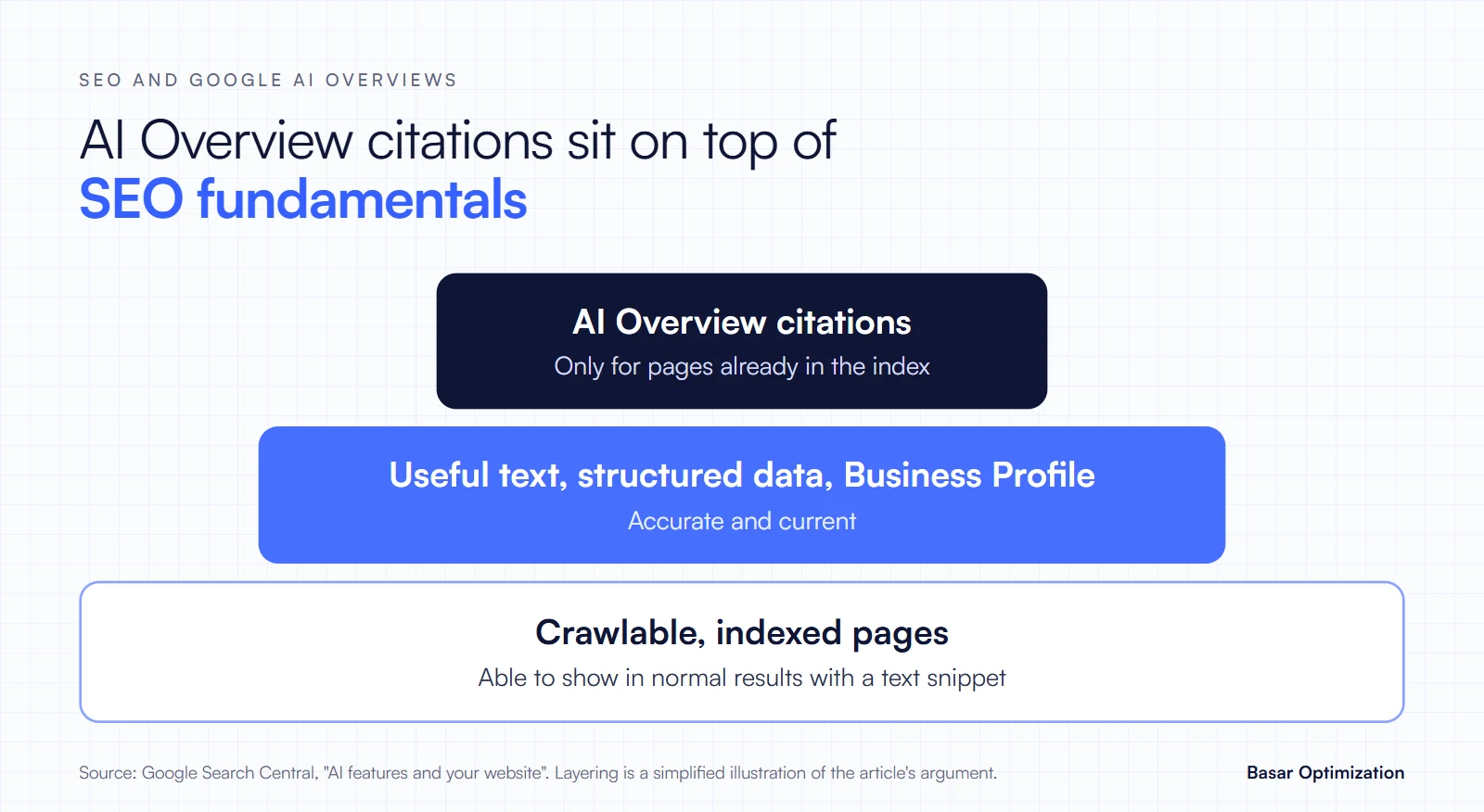
For Google's own AI features, Google says no. It states that standard SEO best practices still apply to AI Overviews and AI Mode, that there are no extra requirements for appearing in them, and that no special files, AI text files or schema markup are needed (Google Search Central, AI features and your website). A page can only be cited there if it is indexed and could already show in normal results with a text snippet.
That is Google's view of its own features. Generative engine optimization (GEO) is a separate discipline: it concerns whether and how a business appears in AI-generated answers, including the sources cited, across generative AI systems, not Google alone. GEO does not replace SEO; it works alongside the same base of crawlable pages, useful text, accurate structured data and a current Business Profile.
Myth 3: You Can No Longer Measure What SEO Does
Measurement has shifted, but it has not disappeared. Google states that appearances in AI Overviews and AI Mode count toward the Performance report in Search Console, filed under the "Web" search type with the rest of a site's search traffic. Search Console is Google's free tool for site owners; it reports the queries, impressions (times a page was shown) and clicks your pages receive.
Impressions and the queries behind them deserve as much attention as raw clicks, and leads, calls and form submissions deserve more than either. Google also suggests pairing Search Console with analytics to track what visitors do after they arrive.
Myth 4: SEO Is a One-Time Fix With a Guaranteed Result
Neither half is true. Google says plainly that no one can guarantee a top ranking (Google Search Central, "Do you need an SEO?"), and it describes its ranking systems as automated systems that weigh many signals and are improved regularly through testing (Google Search Central, ranking systems guide).
A site that was well optimized three years ago can drift as competitors improve, services change and search features move. SEO behaves more like maintenance than construction.
Myth 5: Local Customers Have Moved Past Search
The audience is still online. Statistics Canada reports that 95.2% of Albertans aged 15 and over used the internet in 2022, slightly above the national figure of 94.5% (Statistics Canada, table 22-10-0135-01, released 2023-07-20). Another table shows 76.3% of Canadians 15 and over researched goods or services online that year (table 22-10-0137-01). Neither figure measures search, but both rule out an offline Calgary customer base.
For local services, the more useful question is where the search happens. Google's AI-features checklist includes keeping Business Profile information up to date, tying local visibility to the same fundamentals: an accurate profile, consistent details and pages that match real searches. Why local SEO matters for Calgary businesses covers that side in more depth.
When Is SEO Not Worth It?
An honest answer to "is SEO worth it?" includes the cases where it is not. The evidence points to a few:
- There is little or no search demand. If almost nobody searches for what you sell, or buyers find you only through referrals and tenders, search visibility has limited value.
- The horizon is very short. SEO builds over time and Google publishes no timeline. A business that needs leads within weeks may be better served by paid search while the site improves.
- The website cannot be changed. If you cannot edit pages, fix technical problems or add content, there is little for SEO to work with.
- Nobody will track it. If no one, in-house or at your agency, sets up Search Console and lead tracking, you cannot tell whether it pays off.
Google suggests a small local business can probably do much of the work itself, and it also lists what a good provider adds, such as technical advice and content development. The comparison of doing it yourself and hiring help is covered in whether you can do SEO without an agency, and the role of software is weighed in AI SEO tools versus human SEO experts.
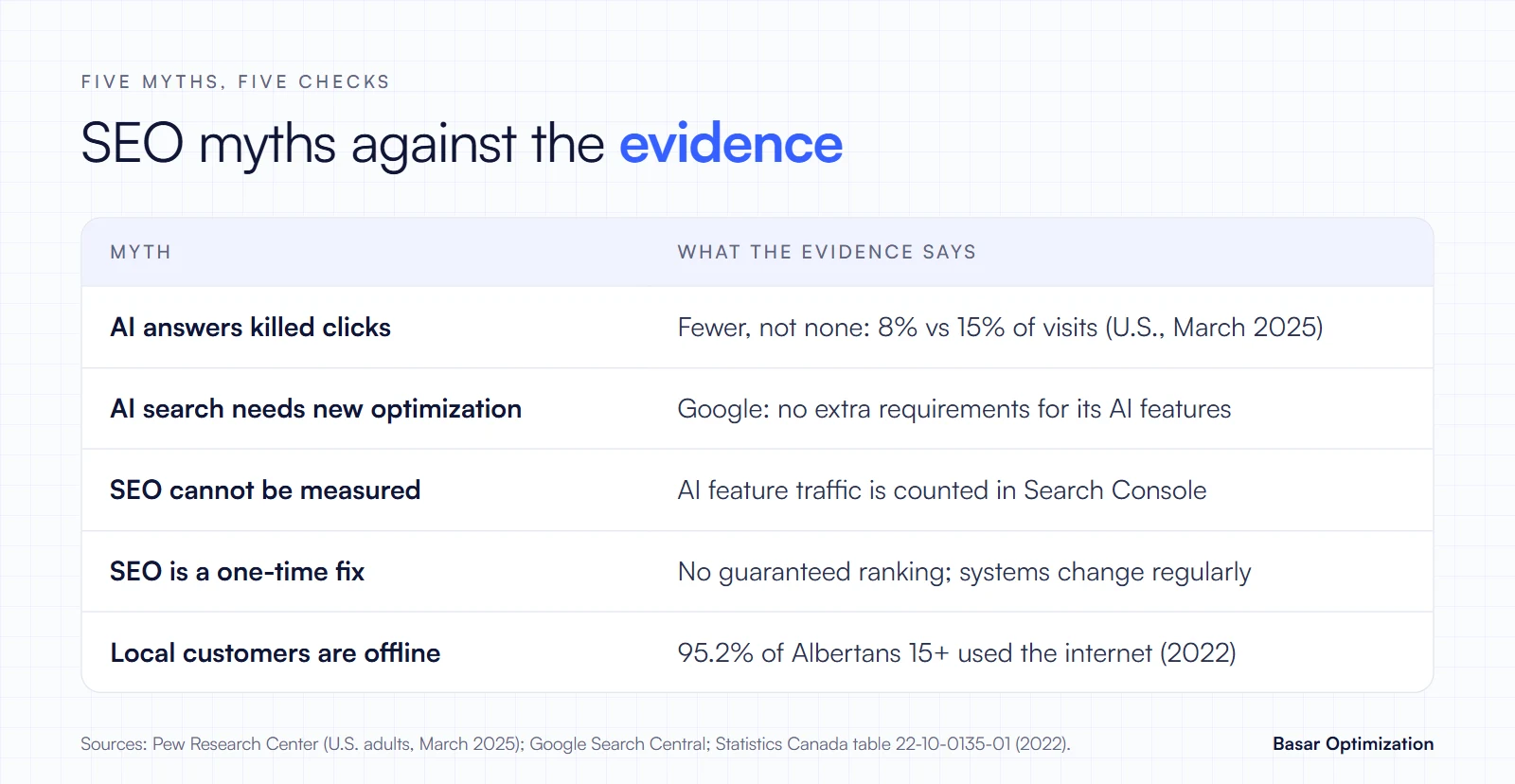
| Myth | What the evidence says | What it means for you |
|---|---|---|
| AI answers killed clicks | Fewer clicks when a summary appears (8% vs 15%, U.S., March 2025) | Value visibility and citations, not clicks alone |
| AI search needs new optimization | Google: no extra requirements for its own AI features | Fundamentals first; GEO works alongside SEO |
| SEO cannot be measured | AI feature traffic is counted in Search Console | Track queries, impressions and leads |
| SEO is a one-time fix | No guaranteed ranking; systems change regularly | Budget for upkeep |
| Local customers are offline | 95.2% of Albertans 15+ online (2022) | The audience is there to reach |
Final Thoughts
Is SEO still relevant heading into 2027? The evidence says yes for businesses with real search demand and the patience to build, with a revised scorecard: visibility, citations and leads rather than clicks alone. It is not dead, and it is not a guaranteed machine either.
Check your own data before deciding. Look at the queries your Calgary SEO pages already earn impressions for, and judge whether a stronger search engine optimization program would reach more of that demand. If you would like that check done with you, you can request a quote and we will look at the numbers together.
Frequently Asked Questions
Is SEO dead because of AI?
No. Google states that its AI Overviews and AI Mode rely on the same SEO fundamentals as regular search, and that a page must be indexed to be cited in them. What has changed is the click pattern: U.S. data from Pew shows fewer clicks when an AI summary appears. Visibility now matters alongside clicks, so the work continues with a broader scorecard.
Is SEO worth it for a small business?
Usually, when people search for what you sell and you can wait for results to build. It is weaker when search demand is very low, when you need leads within weeks, or when the website cannot be edited. Google suggests a small local business can probably do much of the work itself, so the decision is often about how much help to buy.
Do AI Overviews show up in Search Console?
Yes. Google says traffic from AI Overviews and AI Mode is included in the Performance report under the "Web" search type, together with regular search traffic. Google describes it as part of overall search traffic rather than a separate report, so watch the queries and pages that earn impressions and pair Search Console with analytics to see which visits turn into leads.
How do I know whether SEO will pay off for my business?
Start with evidence rather than promises. Check Search Console for the queries your pages already appear for, confirm that people search for your services in your area, and make sure you can track calls and form leads. Be wary of anyone who guarantees rankings or a fixed timeline: Google says no one can guarantee a top position.