
How to Build a Marketing Plan for a Small Business: A Step-by-Step Framework for 2027

A demand-first, measurement-first method for owners who have already spent on marketing once and want the next twelve months to be accountable.
Executive Summary
A marketing plan for small business use is a written schedule of what you will do to win and keep customers over a set period, usually a year, with a named owner, a cost and a measure attached to every activity. Standard marketing-plan structures cover a similar core: an analysis of where the business stands, customer segments, objectives, tactics and a budget.
This paper keeps that sequence but adds two steps that established businesses tend to skip. First, it starts with an audit of what last year's marketing measurably produced. Second, it times activity against search demand data the business already owns or can read for free. The result is a plan you can check every quarter instead of a document that is filed and forgotten.
Scope and Method
The framework is written for small and medium businesses in Calgary and the surrounding area that have traded for at least two years and have tried SEO, Google Ads or an agency before. It applies to service businesses most directly, though the steps hold for retail.
It draws on four kinds of source, all read in November 2026: Innovation, Science and Economic Development Canada (ISED) small-business statistics; Statistics Canada survey data on internet use by Canadians and by Canadian businesses; Google's documentation for Search Console, Google Analytics 4 and Keyword Planner; and Google's own guidance on hiring search help. Search volumes quoted come from Google Ads Keyword Planner for Canada, pulled 2026-11-21.
Two limits apply. The paper does not prescribe a spend percentage, because no rule of thumb fits every margin structure and this framework budgets from tactics upward. It also offers no downloadable template; a plain spreadsheet or document is enough to hold the outputs described below.
What a marketing plan for a small business has to do
A marketing plan turns strategy into specific actions and names who is responsible for each, much as a playbook does for a team. It sits beneath the business's longer-range strategic plan. In a small firm those documents often collapse into one, and that is acceptable as long as the marketing section still answers who, what, when, how much and how you will know.
The competitive case for writing it down is strong in this province. ISED's Key Small Business Statistics 2025 put the number of Canadian employer businesses at 1.10 million in December 2024, of which 98.2% were small businesses (1 to 99 paid employees). Alberta alone had 137,182 small employer businesses, and ISED ranks Alberta and British Columbia jointly first among the provinces for businesses per thousand adults. A Calgary owner is rarely the only credible option a buyer can find, so unplanned marketing tends to compete on noise rather than on fit.
The same ISED edition puts long-run survival in perspective: of small firms started in the services-producing sector, an average of 23.0% survived at least 21 years. Survival has many causes, and marketing is only one of them; the figure is context, not a claim that a plan prevents failure.
How to create a marketing plan: the framework at a glance
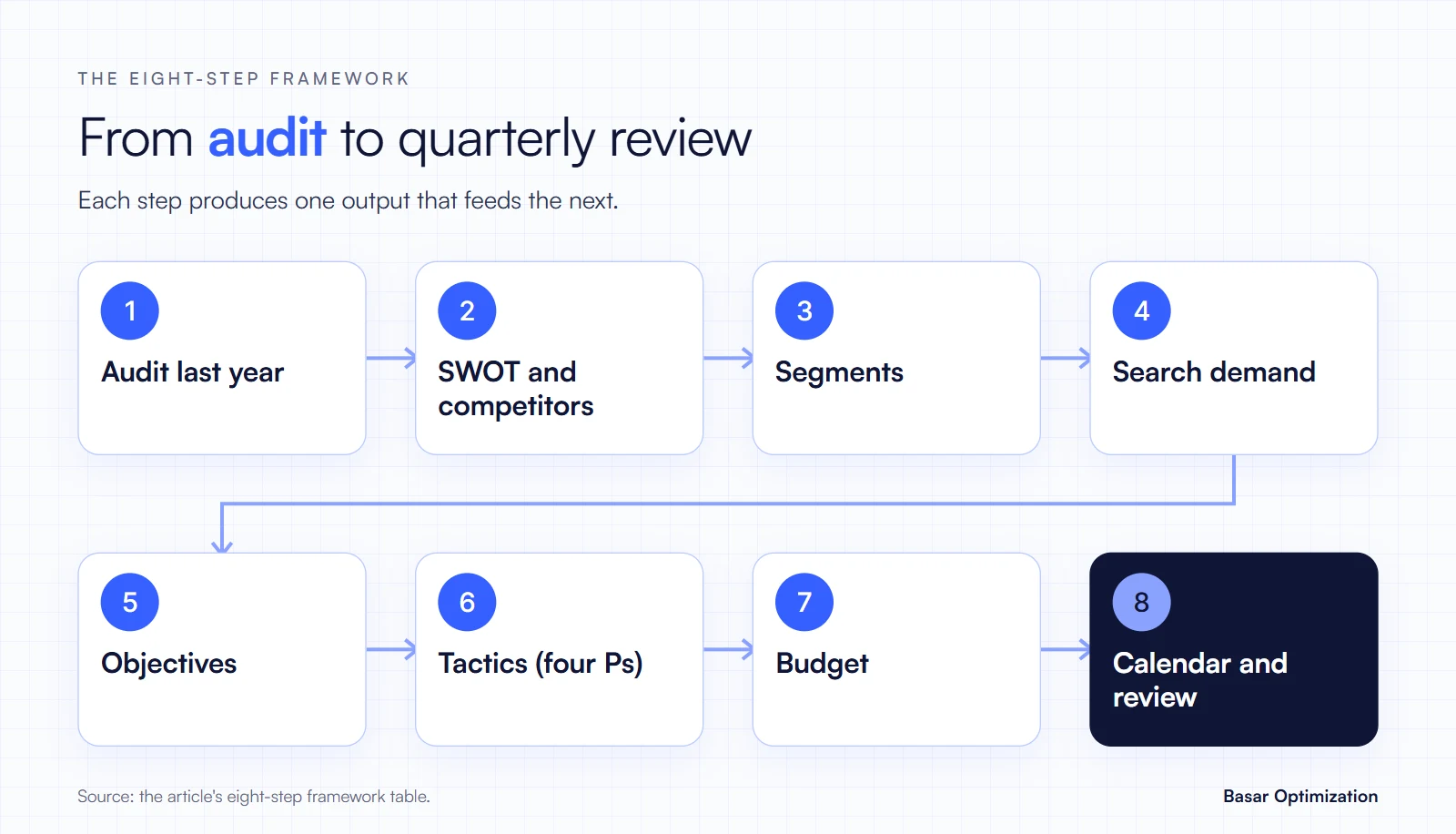
The eight steps below run in order, and each produces one output that feeds the next.
| Step | Question it answers | Main input | Output |
|---|---|---|---|
| 1. Audit last year | What did past spend measurably produce? | Search Console, GA4 key events, ad account conversions | Baseline table and a list of tracking gaps |
| 2. SWOT and competitors | Where do you stand against the alternatives? | Team knowledge, competitor websites and search results | Four short lists and two or three strategic choices |
| 3. Segments | Who is worth marketing to first? | Customer records, sales and service staff | Three or four ranked segments |
| 4. Search demand | When does each segment look for you? | Keyword Planner, Search Console monthly view | A demand calendar by month |
| 5. Objectives | What will count as success? | Baseline from Step 1 | Measurable targets with a source per metric |
| 6. Tactics (four Ps) | What will you offer, where, at what price, through which channel? | Steps 2 to 5 | Tactics per segment |
| 7. Budget | What does each tactic cost? | Quotes, tool costs, staff time | A line-item marketing budget |
| 8. Calendar and review | Who does what, when, and when do you check? | Steps 4, 6 and 7 | A twelve-month calendar with owners and review dates |
Step 1: Audit what last year's marketing measurably produced
An owner who has already paid for SEO or ads has data, even if nobody looked at it. The audit turns that history into a baseline, the starting value each objective is measured against.
Start with Google Search Console, Google's free report on how a site appears in its search results. Its Performance report shows clicks, impressions (how often a page appeared in results), click-through rate (clicks divided by impressions) and average position. The default view covers three months; widen it to the longest range available and switch the chart to monthly so that holiday and weekend noise smooths out. Group the table by query and by page to see which services already attract searchers and which never appear.
Then open Google Analytics 4 and check which actions were tracked. GA4 calls a tracked business action, such as a form submission or a phone-link tap, a key event. Google notes that the key event designation takes effect from the moment it is set and leaves past data untouched, and that a newly marked key event can take up to 24 hours to show in standard reports. If nothing was marked last year, that gap is the audit's first finding, and the fix comes before any new spend.
Finish with the ad account's conversion columns, if one exists. Record each channel's cost, leads and the share of leads that became customers, using your own sales records for the last figure.
Step 2: Run a SWOT and a competitor check
A SWOT analysis lists internal strengths and weaknesses and external opportunities and threats. Strengths and weaknesses only mean something relative to the businesses a buyer compares you with, so the competitor check belongs in the same sitting.
For a local service firm, the practical competitor set is whoever appears beside you for your core service searches, not whoever you consider a rival. Search your main services from a Calgary location, list the businesses that recur, and compare what their pages answer that yours do not. A structured way to do this at keyword level is described in our paper on competitor keyword gap analysis.
Keep each quadrant to four or five items, then write two or three strategic choices that follow from them, for example "lead with same-week availability, which no listed competitor states".
Step 3: Profile and rank your customer segments
A segment is a group of customers who share needs and buying behaviour closely enough to receive the same message. A complete marketing plan describes the market, the segments within it and the strategy for the ones it targets. Start with the customers you already serve: sort them into three or four groups by a trait such as industry or job size, then write down what each group wants, how much it buys and how it decides.
Rank the segments by value and by how reachable they are, and accept that the plan will serve the top one or two most heavily. Owners who believe "everyone" is their customer may find, at this step, that a small number of segments produce most of the profitable work. Customer-facing staff, such as technicians and front-desk teams, hold much of this knowledge, so bring them into the exercise.
Step 4: Put search demand on the calendar
Seasonality is the predictable rise and fall in how often people search for something across the year. Most plans set the calendar by internal habit; this step sets it by when buyers are actually looking.
Google's Keyword Planner gives monthly search estimates for keywords and suggests related ones. Google describes its forecasts as refreshed daily from the last seven to ten days and adjusted for seasonality, and it advises weekly rather than monthly planning when market conditions are shifting. Treat the numbers as estimates, not counts.
As an illustration of the method, the Canadian Keyword Planner data pulled for this paper on 2026-11-21 showed the term "marketing plan" averaging 880 searches a month, with 1,600 in November 2025 and 1,300 in January 2026. A planning-services business reading that pattern would schedule its content and ads for late autumn and January, not for summer. Your own Search Console monthly view adds the second half of the picture: when your site gained and lost impressions for each service.

Step 5: Set objectives you can measure
An objective is useful only if it names a metric, a baseline, a target, a date and the report where it will be read. That is close to the SMART test (specific, measurable, actionable, realistic, time-bound) often applied to plan objectives, and objectives need not be about sales alone: leads and conversion rates count too.
| Objective type | Example metric | Where it is measured |
|---|---|---|
| Lead volume | Qualified enquiries per month | GA4 key events, call tracking, CRM |
| Lead cost | Cost per qualified lead by channel | Ad account plus CRM |
| Conversion | Enquiry-to-customer rate | Your own sales records |
| Visibility | Impressions and clicks for priority services | Search Console |
| Retention | Repeat customers in the year | CRM or invoicing system |
Write each target from the Step 1 baseline, not from an industry average you cannot verify. If the baseline is missing, the first-quarter objective is to establish it. Turning these measures into dashboards is the work of data-driven marketing and reporting.
Step 6: Choose tactics per segment with the four Ps
The four Ps are product, price, place and promotion: what you offer, what you charge, where buyers find and buy it, and how you communicate with them. A plan's strategy section is written for its target markets, covering positioning and the marketing mix, and working through the four Ps segment by segment keeps the plan from defaulting to one message for everyone.
For most local service firms, "place" now means search results and the website as much as a storefront. Statistics Canada's Canadian Internet Use Survey found that 95% of Canadians aged 15 and older used the internet in 2022. Its 2021 business technology survey, covering firms with five or more employees, found 78% had a company website, yet only 59% of those sites were optimized for mobile devices, and 24% of businesses paid for online advertising. On those 2021 figures, a mobile-ready site was a point of difference rather than a given. Promotion choices then follow from the demand calendar: organic search for services with steady demand, paid search where demand is seasonal or urgent, and website improvements wherever traffic arrives but does not convert. Paid search is the fastest of these to switch on and off, which is why Google Ads management often carries the peaks the calendar identified.
Each tactic gets a start date, an end or review date and one person accountable, which is what a plan's action programs are meant to record: what will be done, when, by whom and at what cost. A tactic with no owner is a wish, not a plan item.
Step 7: Build the marketing budget tactic by tactic
A marketing budget, in this framework, is the sum of the costed tactics from Step 6, not a share of sales decided in advance. List every cost a tactic carries: media spend, writing, design, software such as a customer relationship management (CRM) tool, and internal staff hours. This follows the usual order of a marketing plan, in which the budget is derived from the action programs rather than set before them.
For paid search, Keyword Planner shows indicative costs per click, and Google cautions that outcomes rest on your bids and budget, the quality of your ads, where you target and how customers in your industry behave. Our earlier guide to setting a Google Ads budget covers that line in detail.
Then compare the total against what the business can carry. If it is too high, cut whole tactics aimed at lower-ranked segments rather than thinning every line; a thinly funded campaign often produces too little data to judge.
Step 8: Write the calendar, name owners, set the review rhythm
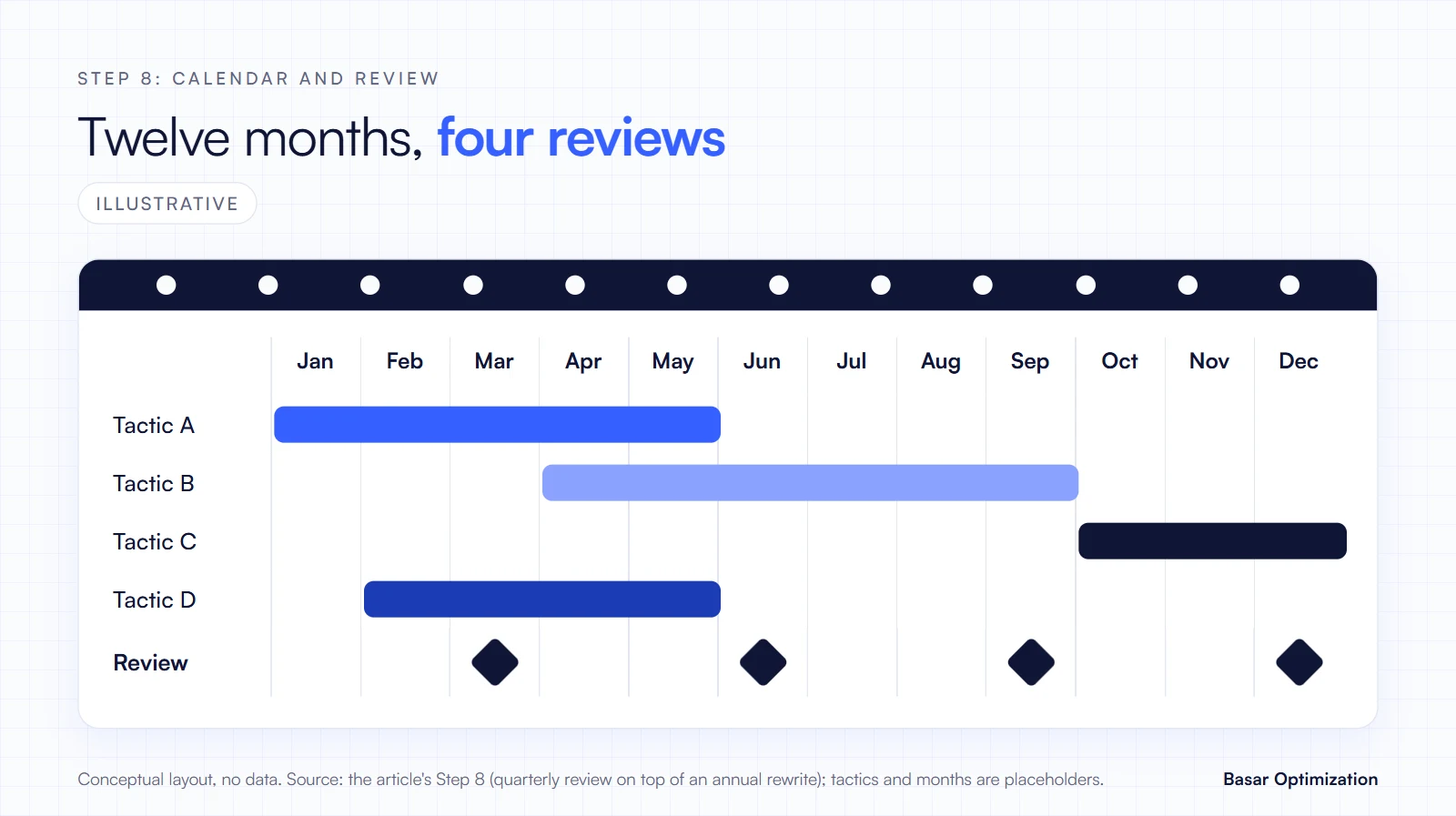
Lay the tactics across twelve months using the demand calendar from Step 4, and mark each review date. A plan conventionally ends with controls: the checks that show when results drift outside the expected range, so the cause can be found and the plan adjusted.
We recommend a lighter quarterly review on top of the annual rewrite: compare each objective's current value with its baseline, keep what is working, and move budget away from tactics that have had a fair run and produced no measurable result. Monthly checks are for spotting tracking breaks, not for changing strategy.
Common mistakes
- Planning before measuring. New spend starts while key events are still unmarked, so nothing can be judged later.
- Repeating last year's channel mix by default. The audit exists to challenge it.
- One segment called "everyone". Messages, keywords and landing pages all blur.
- A single-line budget. Without costs per tactic, there is nothing to cut or scale with precision.
- No owner per tactic. Work slips between staff and outside suppliers.
- Changing tactics every month. Many channels need several months of data before a fair judgment.
When outside help makes sense
Google's guidance on whether you need an SEO states that a small local business can probably handle much of its own search work, and it suggests asking any prospective provider what results to expect, over what timeframe, and how success will be measured. The same questions apply to anyone helping with a whole plan.
Help is most valuable at Steps 1, 4 and 5, where tracking and data interpretation decide whether the rest of the plan can be evaluated. A custom marketing strategy engagement reviews your goals, current activity and data, defines objectives and conversion measures, and sets out a plan with agreed next steps; part-time senior oversight is what a fractional CMO provides; and our marketing strategy overview shows how both connect to SEO, paid media and web work.
What this means for your business
If you have marketed before, your plan should begin with evidence you already hold. Search Console and GA4 will show what worked, what was never measured, and which services buyers search for and when. That evidence turns segments, objectives and tactics from opinions into choices you can defend.
Expect the first version to be imperfect. Its value lies in making each quarter's results comparable with the last, so that the 2028 plan rests on a year of clean data rather than memory.
Conclusion
A marketing plan for a small business does not need to be long; it needs to be specific. Audit last year, rank your segments, read the demand calendar, set measurable objectives, cost every tactic and review on a fixed rhythm. Each step produces an output the next step depends on, which is what separates a working plan from a list of ideas.
If you would like an experienced second reader for the plan you draft, you can request a quote and we will go through it with you.
Frequently Asked Questions
How long does it take to write a marketing plan?
There is no standard figure; it depends mostly on how much usable data you already hold. Much of the time goes into gathering a baseline from Search Console, analytics and sales records. If tracking was never set up, add the time needed to mark key events and let data accumulate before setting firm targets.
How do you make a marketing plan if you have never written one?
Work through the steps in order: audit existing results, run a SWOT and competitor check, define three or four customer segments, map search demand by month, set measurable objectives, choose tactics per segment, cost each tactic, and place everything on a twelve-month calendar with owners. A simple spreadsheet or document gives the outputs a home.
How much should a small business spend on marketing?
No single percentage suits every business, because margins, competition and growth goals differ. A more reliable method is to cost each planned tactic, including media, content, tools and staff time, then compare the total with what the business can sustain. Cut lower-priority tactics whole rather than underfunding everything, so each remaining tactic produces enough data to judge.
How often should a small business update its marketing plan?
Rewrite the plan once a year and review it every quarter. The quarterly review compares each objective with its baseline and moves budget from tactics that have had a fair trial without measurable results. Monthly checks are best limited to confirming that tracking still works and that spend is pacing as planned.
Do I need an agency to write my marketing plan?
Not necessarily. Google says a small local business can do much of its own search work. Help is most useful for setting up measurement, interpreting search data and allocating spend. If you hire, ask what results to expect, over what timeframe, and how success will be measured.