
Market Segmentation for Small Businesses: How to Choose the Customers Worth Marketing To

Market segmentation is the process of dividing a market into groups of buyers who share needs and behaviour closely enough to respond to the same offer and message. For a small business, its real purpose is choice: deciding which one or two groups deserve most of a limited marketing budget, and then building search terms, ads and pages around them.
What is market segmentation?
Segmentation means finding groups of buyers, whether people or organizations, whose shared needs make them likely to react alike to one message. Targeting follows: you segment to see how groups differ, then choose which of them get your marketing effort. Segmentation is research rather than promotion, and for an established business it means reorganizing customers you already know into groups you can act on.
The four bases, and their B2B equivalents
Most consumer segmentation uses four bases, meaning the characteristic you group people by. A common shorthand tags each base with a question. Geographic answers "where": location, climate or season, language, and urban, suburban or rural setting. Demographic answers "who": age, education, occupation, family structure and similar facts. Behavioural answers "how": benefit sought, purchase occasion and usage rate. Psychographic answers "why": lifestyle, personality and values.
Business-to-business (B2B) markets use firmographics, the company-level version of demographics: industry, location, size and legal structure. B2B purchases often involve a buying centre, several people with a say, so the real buyer is harder to identify. Size alone rarely separates Canadian prospects: the federal government's Key Small Business Statistics 2025 classes 98.2% of employer businesses as small (1 to 99 employees) in December 2024. For a commercial cleaning company, an office tower's procurement team and a single dental clinic are different segments, even within one postal code.
Market segmentation examples for service businesses
The table shows how each base might look for local service firms. The businesses are hypothetical and illustrate the method only.
| Base | Hypothetical business | Example segment |
|---|---|---|
| Geographic | Furnace repair company | Homes in older communities with original heating systems |
| Demographic | Home-care provider | Adult children arranging care for parents aged 65 and over |
| Psychographic | Landscaping firm | Owners who value native, low-water planting |
| Behavioural | Auto repair shop | Customers who book only after a breakdown, not for maintenance |
| Firmographic (B2B) | Bookkeeping practice | Construction subcontractors with seasonal cash flow |
Customer segmentation: which segments are worth it?
Customer segmentation is the same exercise applied to your existing customer base rather than the wider market. Behaviour often tells you more than demographics: two buyers who look identical on paper can want different benefits from the same product.
For a business with a few years of invoices, a value-based method (sometimes called tiering) is practical: group customers by how much they buy, how often, and what those purchases are worth. We suggest spending effort in proportion to the tiers: personal attention for the top group, periodic contact for the next, and automated or online service for occasional buyers.
Value is only half the test. Concentrated, or niche, marketing suits smaller firms with limited resources: identify several segments, then serve only those that are attractive and suit your strengths. For most small businesses that means one or two priority groups at a time. Combine the two views and rank each candidate segment on three questions:
- Value: Do these customers buy often, at healthy margins, and come back?
- Fit: Is your service clearly better for them than the alternatives they can find?
- Reach: Can you identify and reach them efficiently, through search terms, locations or industries?
A segment that scores well on all three earns the largest share of the plan. A segment that is valuable but unreachable belongs in a referral or account-management effort rather than in advertising.
Where Calgary businesses can find segment data
Your own records come first: invoices, job addresses, enquiry forms and the notes of staff who talk to customers. For a business that has traded for a few years, most of the evidence already sits in those files.
For geographic and demographic segments, the City of Calgary publishes a free population profile built on census data, with ward and community breakdowns. Its 2021 Census figures put the city's population at 1,306,780. Residents aged 65 and over numbered 177,405 in that census, roughly one Calgarian in seven, and the group had grown by 28 per cent since 2016; the city's median age was 38. Data of that kind can tell a home-care provider or an accessibility renovator which communities to prioritize. Treat it as dated: census figures describe 2021. Older segments are easier to reach online: Statistics Canada's Canadian Internet Use Survey found internet use among Canadians aged 75 and older rose from 62% in 2020 to 72% in 2022.
Turning a segment into keywords, ads and pages
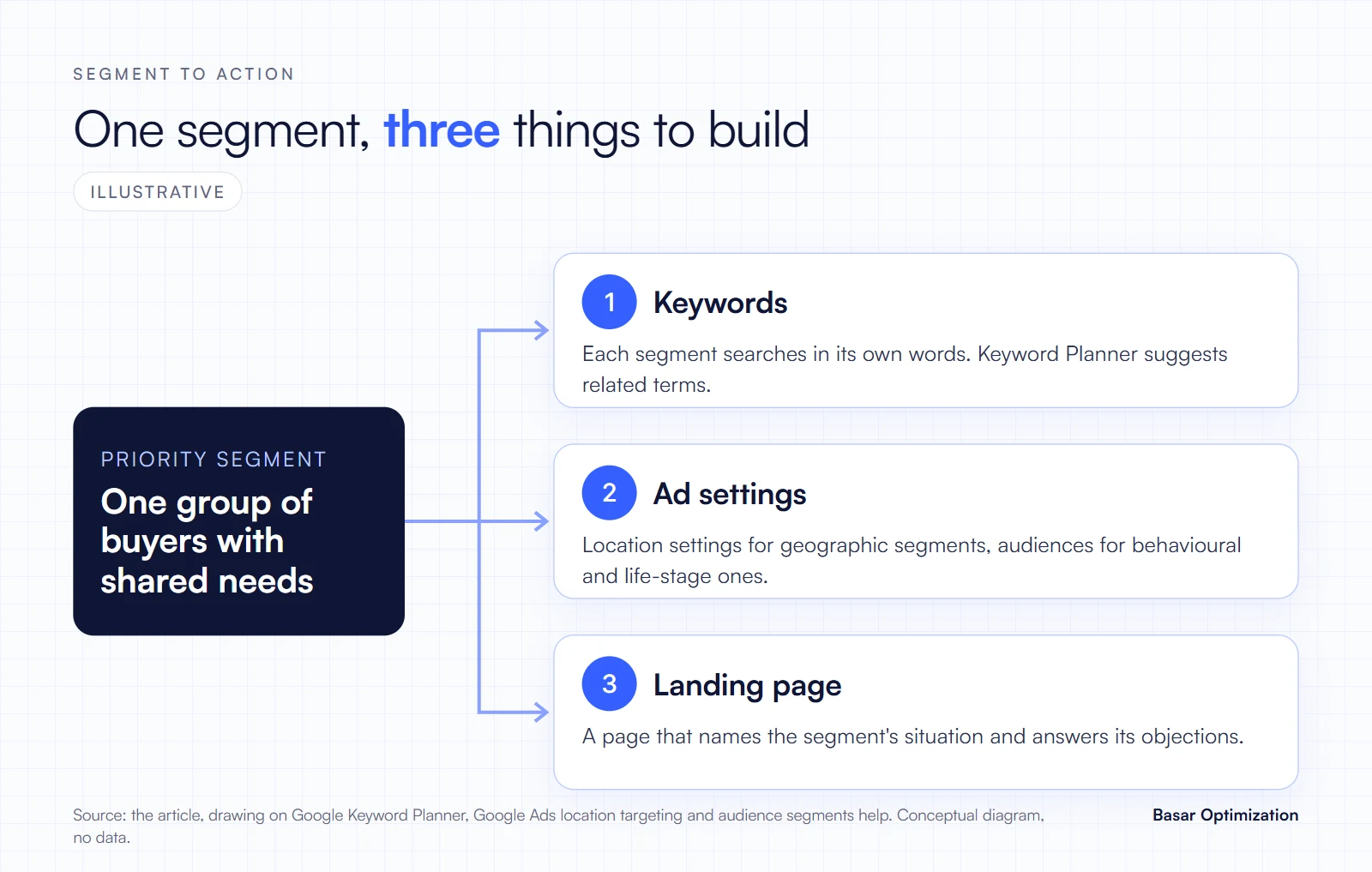
A segment only becomes useful when it changes what you publish and where you spend. Three translations do most of the work.
Keywords. Each segment searches in its own words. Google's Keyword Planner suggests related terms and monthly estimates from a seed phrase or a website, so you can test whether "commercial snow removal" and "driveway snow clearing" attract separate audiences worth separate pages. Building local pages and content around those terms is part of local SEO.
Ad settings. Google Ads lets you aim ads at people located in, or showing interest in, a place you choose, according to its help page on location targeting. Its audience segments add groups based on interests, active research, life facts and past interaction with your business, as estimated by Google. A geographic segment maps to location settings; behavioural and life-stage segments map, roughly, to audiences. Configuring both around real segments is part of Google Ads management.
Landing pages. Give each priority segment a page that names its situation and answers its specific objections. One page aimed at "everyone" usually reads as if it were written for no one.
How to tell whether a segment is working
A segment choice is a hypothesis until results confirm it. Give each priority segment its own measurable path: a dedicated landing page, a distinct campaign or ad group, or at least a form field that records which situation the enquirer is in. In Google Analytics 4, mark the enquiry form and phone-link tap as key events, Google's term for the actions you treat as conversions, so that enquiries can be compared page by page.
Then review three numbers per segment each quarter: enquiries, the share that became paying customers, and the cost of winning each one. A segment that brings plenty of enquiries but few customers usually signals a fit problem, while one that converts well but produces little volume may simply need more reach. Either finding is useful, because it tells you whether to change the message, the budget or the segment itself.
Final Thoughts
Market segmentation for a small business is not a branding exercise or a slide deck. It is a sorting decision with direct consequences: which searches you compete for, where your ads appear and which pages you build first. Use your own sales data to rank segments by value, fit and reach, add public census data where geography or age matters, and concentrate on one or two groups until results justify widening.
This work sits inside a broader custom marketing strategy, and it is usually the step that makes the rest of the marketing strategy easier to measure. If you want an outside view on which of your segments to prioritize, you can request a quote and we will review them with you.
Frequently Asked Questions
What are the four types of market segmentation?
The four common bases are demographic (facts such as age or occupation), geographic (where buyers are), psychographic (values, interests and lifestyle) and behavioural (how and how often people buy). Business-to-business firms use firmographics instead, such as industry, company size and location, along with who makes the buying decision.
What is the difference between segmentation and targeting?
Segmentation is the research step that divides a market into groups with shared needs or behaviour. Targeting is the decision about which of those groups to pursue and the marketing aimed at them, including the message, the offer and the channels. Segmentation without targeting produces a report; targeting without segmentation tends to waste budget.
How many segments should a small business target?
Usually one or two at a time. Concentrating on a small number of well-matched segments suits firms with limited resources, because effort spread across every group gets thin. Other customers are still served; they simply receive less marketing effort until the priority segments are performing and the budget allows expansion.
Is customer segmentation useful for a B2B service company?
Yes. A B2B firm can group accounts by industry, size, location and buying frequency, then rank them by value. The most valuable accounts often warrant personal attention, while occasional buyers can be served through automated email and online ordering. Segments also clarify which industry terms to target in search.